


The Complete Hand Tool Kit Guide for UAE Homes & Sites
A useful hand tool kit is not the biggest box on the shelf. It is a balanced set that covers measuring, fastening, gripping, cutting, striking and routine maintenance without filling the case with duplicate or unsuitable tools. UAE homeowners may need a compact kit for furniture, shelving and emergency repairs, while technicians and construction teams need durable, task-specific equipment supported by inspection, storage and replacement procedures.
This guide explains how to choose a practical kit, what belongs in each tool group and how to separate household tools from equipment intended for professional site use. You can also browse the current FEPY hand tools category to compare individual tools, accessories and larger workshop sets.
Start with the work, not the tool count
A “100-piece” label can be misleading. Some sets reach a high count by including many small driver bits, sockets or consumables while omitting essentials such as a reliable measuring tape, locking pliers or a suitable hammer. Begin by listing the jobs the kit must support.
For a UAE home, common tasks include assembling furniture, tightening cabinet hardware, hanging lightweight fixtures, adjusting hinges, opening appliance panels and handling minor plumbing maintenance. A site kit may support setting out, mechanical fastening, cable preparation, formwork checks, finishing work or equipment servicing. Each trade should select tools that match its approved method statement and risk assessment rather than treating one general kit as suitable for every operation.
Measuring and marking tools
Accurate work begins before cutting or drilling. A general kit should include a tape measure with a clear scale, a short spirit level, pencils or markers and a square. A square helps check 90-degree corners when setting shelves, frames, tiles or joinery. For larger work, a longer rule, chalk line or specialist measuring instrument may be needed.
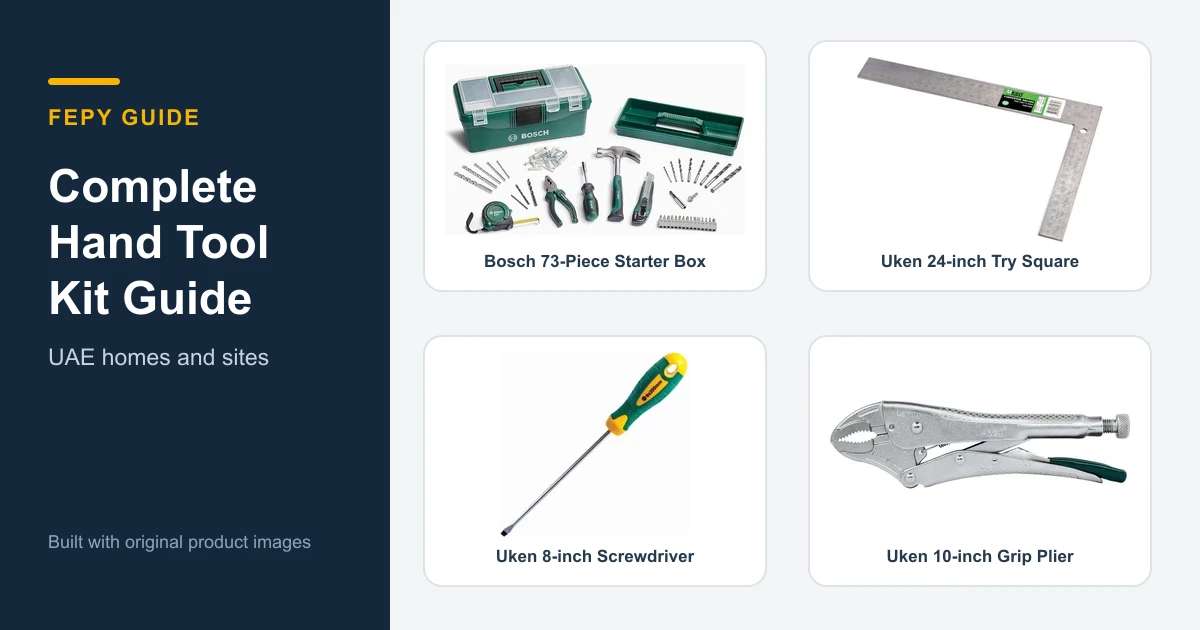
The Uken TRY Square 24" U30-060 is an example of a dedicated checking and marking tool for larger workpieces. It should be stored so the blade cannot bend, and its accuracy should be checked if it is dropped. Digital angle tools and laser measures can improve speed on professional projects, but users must still understand reference surfaces, calibration and the limitations of the instrument.
Marking materials should suit the surface. A permanent marker may damage finished stone or joinery, while an unsuitable chalk colour can stain a porous surface. Test in an inconspicuous area and follow the project’s finishing requirements.
Screwdrivers and fastening essentials
A starter kit normally needs flat and Phillips screwdrivers in several sizes. Pozidriv, Torx, hex keys or precision drivers may be necessary depending on furniture, appliances and equipment. The tip must fit the fastener correctly: using an undersized or incorrect profile damages the screw and increases the chance of the driver slipping.
The Uken Screw Driver 8" represents a single full-size driver rather than a complete multi-profile set. Buyers should confirm the tip type and size before ordering. For frequent maintenance, a selection of fixed drivers is often easier to control than relying entirely on one interchangeable-bit handle.
A voltage tester is not a substitute for a properly rated test instrument or safe electrical isolation. The Uken Tester 210 mm U6017 should only be used within its manufacturer-stated purpose and rating. Electrical work in the UAE must be handled by competent persons using approved procedures, suitable personal protective equipment and verified test equipment.
Pliers, gripping and adjustable tools
Combination pliers, long-nose pliers and side cutters cover many routine gripping and wire-handling jobs. Add an adjustable wrench for nuts and fittings, but use correctly sized fixed spanners or sockets where high torque or repeated work is involved. Adjustable jaws can slip if poorly set.
Locking pliers are helpful for holding, clamping or turning suitable components. The Uken Grip Plier 10" / U6749 is one catalogue example. Locking pliers should not be used as a permanent clamp, on live electrical parts or where their serrated jaws could damage a finished surface. Inspect the adjustment screw, release lever and jaw condition before use.
Keep plier pivots clean and lightly maintained according to the manufacturer’s guidance. Do not extend handles with pipes to gain leverage; choose a tool designed for the required load.
Hammers, chisels and striking tools
A claw hammer is useful for general household and carpentry tasks, while club, ball-peen, rubber or dead-blow hammers serve different trades. Match the hammer face, weight and handle to the work. Never strike hardened components together unless both tools are intended for that use.
Chisels must also match their application. A cold chisel, masonry chisel and wood chisel are not interchangeable. The Total Pointed Chisel TAC153172 is a specific pointed accessory; buyers must verify compatible equipment and intended material before use. Mushroomed striking heads, cracked handles and damaged cutting edges are reasons to remove a hand tool from service.
Eye protection is particularly important during striking, cutting and chipping because fragments can travel beyond the immediate work area. Site teams should also control the exclusion zone, noise, dust and flying debris.
Cutting, scraping and surface preparation
A household kit may include a retractable utility knife, spare blades and a small hacksaw. Professional kits may require cable cutters, aviation snips, pipe cutters, files, scrapers or trade-specific saws. The safest cutter is one designed for the material and kept sharp enough to work without excessive force.
Wire brushes remove loose rust, scale and debris from suitable surfaces. Catalogue choices include the Uken Wire Brush and Clarke Wire Brush. Confirm the brush material and surface compatibility, especially on stainless steel, soft metals, coatings or decorative finishes. Wear eye protection and gloves, and replace a brush that is shedding wires or has a damaged handle.
Never carry an exposed blade loose in a toolbox. Retract it or use a sheath, dispose of used blades in a puncture-resistant container and keep cutting tools away from children and unauthorized users.
Masonry, tiling and finishing additions
Building maintenance in UAE villas, apartments and project sites often involves masonry, plaster, grout or tile work. A finishing kit may therefore need trowels, floats, mixing tools, tile spacers and suitable measuring equipment. The Uken Karandi Trowel 7" H/D U1232 is an example of a task-specific masonry tool.
Large manual tile cutters and powered mixers do not belong in a general household hand-tool case. They should be selected separately based on tile dimensions, material, power requirements and the contractor’s work method. Keep wet-work tools clean, because hardened cementitious residue can affect balance, edges and future performance.
Complete sets versus building your own kit
A preconfigured set can provide organized storage and consistent tool families. The Bosch 2607011660 DIY 73-Pieces Starter Box, Accessories Set is a compact catalogue option for buyers who want a grouped accessory selection.
Before choosing any set, check the complete item list rather than relying on the piece count. Confirm drive sizes, measurement units, screwdriver profiles, socket range and whether replacement parts are available. A custom-built kit costs more initially in some cases, but it lets the user choose the correct quality level for each frequently used tool.
Storage for UAE heat, humidity and dust
Tools last longer when they are clean, dry and organized. UAE coastal humidity can encourage corrosion, while construction dust can enter ratchets, pivots and cases. Wipe tools after use, remove cement or chemical residue promptly and store them indoors in a closed box or cabinet. Silica-gel packs or suitable corrosion protection can help in humid environments, but they do not replace dry storage.
Do not leave tool cases in direct sunlight or a parked vehicle for long periods. Heat can degrade plastic handles, foam inserts, batteries and adhesives. Keep tools away from water, solvents and incompatible chemicals. On sites, use controlled tool storage and an issue/return process so missing or damaged items are identified before the next shift.
Inspection and replacement checklist
Before each use, check handles, insulation, jaws, tips, cutting edges, moving parts and locking mechanisms. Remove the tool from service if it is cracked, loose, heavily corroded, modified or no longer holds its adjustment. Do not repair insulated electrical tools with ordinary tape or grind tools into an unapproved shape.
For a new kit, inventory every item and record specialist tools that require calibration or periodic inspection. Home users should review their kit after a major job; site teams should follow the employer’s inspection frequency and manufacturer instructions.
Hand tool kit buying checklist
Use this checklist before ordering:
- Define whether the kit is for home repairs, a particular trade, vehicle work or a shared workshop.
- Check exact tool sizes and profiles rather than the advertised piece count.
- Confirm that electrical tools and testers carry the correct rating for the task.
- Choose corrosion-resistant storage appropriate for UAE humidity and dust.
- Separate cutting tools, sharp accessories and chemicals from general storage.
- Budget for replacement blades, bits and frequently worn components.
- Select suitable eye, hand and other task-specific protection separately.
- Verify every linked product’s current description, availability and price before purchase.
A thoughtful kit should make common work safer and faster while preventing improvisation with the wrong tool. Start with reliable measuring, fastening, gripping, striking and cutting essentials, then add only the trade-specific items the work genuinely requires.