

By Khalid Al Mansoori, Senior Procurement Specialist | Published: April 2026
Having specified and sourced fixings for MEP installations, façade cladding, and fit-out projects across Dubai, Abu Dhabi, and Sharjah over the past 12 years, I've seen firsthand what happens when the wrong anchor meets the wrong substrate — suspended ceilings that drop, curtain wall brackets that pull out, and rebar splices that fail pull-out testing on site. In UAE construction, fixings are never a procurement afterthought. The combination of high-strength concrete in towers, porous AAC blocks in villas, coastal salt air, and ambient temperatures pushing 50°C creates one of the most demanding anchor environments in the world. This guide gives you the technical foundation to specify, buy, and install the right fixing for every substrate and load condition you'll encounter on a UAE site.
Why Fixings and Anchors Are Critical in UAE Construction
A fixing failure in a UAE context is rarely just a maintenance issue — it can be a life-safety event. Dubai Municipality and Abu Dhabi's Department of Urban Planning and Municipalities both require structural anchors in critical applications (façade cladding, suspended ceilings above occupied spaces, MEP pipe hangers in high-rise shafts) to be specified by a structural engineer and, increasingly, to carry ETA (European Technical Assessment) approval. Beyond compliance, the sheer diversity of substrates on a typical UAE project — reinforced concrete cores, hollow concrete blocks, AAC (autoclaved aerated concrete) infill, gypsum drywall partitions, and occasionally original coral-and-lime sandstone in older villas — means a one-size-fits-all approach to fixings will always produce failures somewhere.
Types of Wall Plugs and Anchors Used on UAE Sites
Plastic Wall Plugs (Rawl Plugs): Sizes, Colours and Load Limits
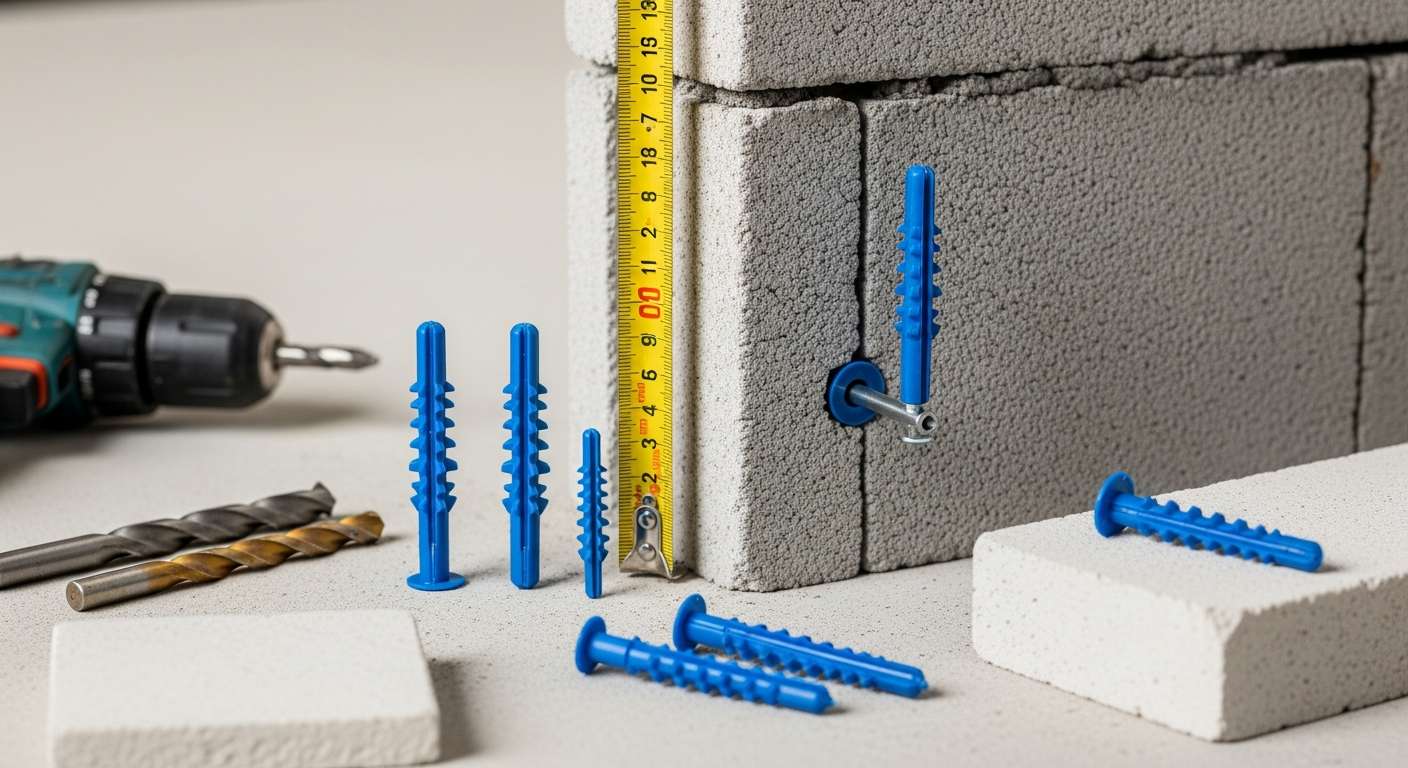
The nylon wall plug — generically called a rawl plug after the brand that popularised it — is the most common fixing on any UAE site. They are sold in colour-coded sizes universally recognised across the industry:
- Yellow (S6): 6 mm diameter, suits screws M3–M4, typical pull-out in solid concrete ~0.8–1.2 kN. Used for lightweight cable clips, signage, and light fixture brackets.
- Red (S8): 8 mm diameter, suits screws M4–M5, pull-out in solid concrete ~1.5–2.0 kN. The most common general-purpose site plug.
- Brown (S10): 10 mm diameter, suits screws M6, pull-out in solid concrete ~2.5–3.5 kN. Standard for medium-load applications like curtain rails, pipe clips, and cabinet mounts.
- Grey (S12–S14): 12–14 mm diameter, suits screws M8–M10. Used for heavier mechanical and structural brackets.
Critical point for UAE sites: nylon plugs in AAC block perform significantly below their rated load in solid concrete — by as much as 40–60% — because the block matrix is porous and low-density. For AAC, use frame plugs with large flanges specifically designed for lightweight substrates, or switch to a chemical anchor.
Brands supplying nylon plugs to the UAE market include Rawlplug, Fischer, Würth, Hilti, TOX, and local distributor-branded variants. Quality varies — cheaper no-name plugs often use recycled nylon with lower tensile strength and will creep under sustained load in UAE heat.
Expansion Bolts: Wedge, Sleeve and Bolt Anchors Explained
Expansion anchors work by mechanical interlock — a bolt or pin drives an expansion element outward to grip the hole wall. Three types dominate UAE commercial and industrial sites:
Wedge Anchors (Stud Anchors): A threaded rod with a wedge clip at the base. As the nut is tightened, the clip expands against the concrete. Wedge anchors are the workhorse for structural steel baseplates, heavy machinery anchoring, and column base connections. Typical embedment depths range from 60 mm to 190 mm depending on bolt diameter (M8 to M24). Pull-out strength in C20/25 concrete can reach 30–60 kN for M16 anchors [ETA-approved manufacturer data]. Always install into fully cured, solid concrete — wedge anchors are not suitable for hollow block or AAC.
Sleeve Anchors: An internally threaded bolt surrounded by an expanding sleeve. Common for suspended ceiling grid hangers, MEP pipe support channels (Unistrut / cable tray), and façade sub-frame fixings. Available in zinc-plated steel (interior use) and A4 stainless steel (coastal or external use). Sleeve anchors are easier to install than wedge anchors because the bolt can be removed and replaced after the sleeve is set.
Drop-In Anchors: A female-threaded expansion shell set flush with the concrete surface, activated by a setting tool before the threaded rod is inserted. Ideal for overhead suspended ceiling work where the anchor must be set before the threaded rod or hanger is attached. Pull-out strength for M10 drop-in anchors in C25 concrete is typically 12–18 kN [ETA data]. Setting tool selection is critical — an incorrectly set drop-in anchor will pull out at a fraction of rated load.
Chemical Resin Anchors: Vinylester vs Epoxy for UAE Conditions
Chemical anchors (resin anchors) bond a threaded rod or rebar into a drilled hole using a two-component adhesive. They are the premium solution for high-load, cracked-concrete, and seismic applications, and are mandatory in many façade engineering and post-installed rebar specifications across UAE high-rise projects.
Vinylester resin is the most common chemical anchor chemistry in the UAE. It cures faster than epoxy, handles damp holes better, and is suitable for most structural applications. Gel times at 35°C are typically 5–8 minutes; at 45°C, gel time drops to 2–4 minutes [manufacturer technical data sheets] — meaning in UAE summer, you must work in small batches and inject immediately after drilling and cleaning.
Epoxy resin offers higher bond strength, better chemical resistance, and superior performance at sustained elevated temperatures. For rebar connections in post-tensioned slabs, transfer beams, or any application where long-term load at high temperature is a concern, epoxy is the correct choice. The trade-off is longer cure time and less tolerance for damp or dusty holes.
Post-Installed Rebar Connections Using Chemical Anchors: One of the most technically demanding applications in UAE construction is drilling into existing concrete and chemically anchoring rebar to extend or connect structural elements — common in villa extensions, slab thickening, and tower podium connections. This work must follow ETAG 001 / ETA guidelines [IEC technical guidance framework] and typically requires an engineer's sign-off and pull-out testing on site. Hole cleanliness is non-negotiable: blow out, brush, blow out again — minimum three cycles. One contaminated hole can reduce bond strength by 50% or more.
Key brands supplying chemical anchors in the UAE: Hilti (HIT-RE 500 V4, HIT-HY 270), Fischer (FIS EM, FIS V Plus), Rawlplug (R-KEM II), Würth (WIT-PE 1000), Sika (AnchorFix range), and Mapei (Planfix Anchoring).
Toggle Bolts and Hollow Wall Anchors for Drywall Partitions
UAE fit-out projects — hotels, office refurbishments, residential apartments — use gypsum board (drywall) partitions extensively. Standard nylon plugs are useless in 12.5 mm or 15 mm gypsum board. The correct fixings are:
- Spring toggle bolts: A spring-loaded wing mechanism folds to pass through the hole, then springs open on the hollow side. Suitable for light loads — TV brackets on drywall (check the bracket's recommended fixing load), mirror mounts, light shelving. Typical pull-out in 12.5 mm gypsum board: 0.3–0.6 kN.
- Metal cavity anchors (Molly bolts): A metal sleeve that collapses behind the board as the screw is tightened. More reliable than plastic versions in UAE humidity. Suitable for loads up to ~0.8 kN in standard gypsum board.
- Snap toggles / strap toggles: A nylon strap with a metal bar — the bar is pushed through the hole and pulled tight against the inner face. Once locked, the bolt can be removed and replaced. Higher load capacity than spring toggles.
For anything heavier — wall-mounted sanitary ware, heavy mirrors, mechanical equipment on drywall — fix into the metal stud, add a timber noggin behind the board, or core through to the concrete behind. Do not rely on drywall anchors alone for loads above 1 kN.
Undercut Anchors for Seismic and High-Load Structural Use
Undercut anchors (e.g., Hilti HDA, Fischer FAZ II) use a special drill bit to create a bell-shaped undercut at the bottom of the hole. The anchor expands into this undercut, creating a form-fit mechanical interlock rather than relying purely on friction. This gives significantly higher pull-out resistance and, critically, much better performance under seismic loading — a growing requirement in UAE projects following updated seismic zoning under ASCE 7 guidelines adopted in UAE structural codes. If a structural engineer specifies a "seismic-rated anchor," undercut or bonded anchors with ETA Option 1 (for use in seismic performance category C2) are the appropriate products.
Anchor Selection by Substrate: Concrete, AAC Block, Drywall, Brick
| Substrate | Recommended Anchor Type | Notes for UAE Sites |
|---|---|---|
| Solid reinforced concrete (C20–C40) | Wedge anchor, sleeve anchor, drop-in, chemical anchor | Dominant substrate in UAE high-rise cores and podiums |
| Cracked concrete / seismic zone | ETA Option 1 chemical anchor, undercut anchor | Specify ETA approval explicitly — many standard anchors are NOT rated for cracked concrete |
| AAC block (e.g., Ytong, Siporex) | Frame plug with large flange, AAC-specific nylon anchor, chemical anchor with mesh sleeve | Never use standard wedge or sleeve anchors — low bearing strength of AAC will crush |
| Hollow concrete block | Hollow-wall sleeve anchor, chemical anchor with mesh sleeve (perforated injection) | Mesh sleeves allow resin to fill the voids and create a solid anchor zone |
| Gypsum board / drywall | Toggle bolt, metal cavity anchor, snap toggle | Always check stud location for heavier loads; fix into metal stud where possible |
| Sandstone / old masonry (UAE villas) | Chemical anchor (epoxy), large-diameter nylon frame plug | Test each location — sandstone quality varies enormously; pull-out test mandatory for structural use |
| Brick (fired clay) | Nylon frame plug, chemical anchor | Avoid high-expansion anchors that can split older brickwork |
Load Ratings, Standards, and UAE Regulatory Requirements
ETA Approval, CE Marking and UAE Municipality Acceptance
The European Technical Assessment (ETA) is the most widely accepted anchor approval document in the UAE market. Dubai Municipality and Abu Dhabi's engineering departments routinely accept ETA-approved anchors as evidence of suitability for structural use. The ETA document covers characteristic resistance values for tension, shear, and combined loading in multiple concrete grades — values that a structural engineer needs to size the anchor correctly.
If you are procuring anchors for a structural application (façade brackets, staircase balustrades, suspended ceiling above public spaces, MEP hangers in critical areas), always request the ETA certificate from the supplier. A product without ETA for structural applications is a procurement risk — it may be rejected by the consultant or municipality inspector on site.
For fire-rated fixing applications — anchors penetrating or supporting fire-rated constructions — look for anchors tested under EN 1366-5 or similar fire resistance standards. Fischer and Hilti both publish fire performance data for their anchor ranges.
Refer to the Dubai Municipality Building Code requirements for structural fixing specifications and approved materials in Dubai projects.
Embedment Depth, Edge Distance and Spacing: Getting It Right
Three installation parameters control anchor performance, and all three are routinely violated on UAE sites:
- Embedment depth (hef): The depth the anchor body engages in the base material. Deeper embedment = higher load capacity. Never guess this — use the manufacturer's ETA or technical data sheet for your specific anchor and concrete grade.
- Edge distance (c): The distance from the anchor centreline to the nearest concrete edge. Too close to an edge and the concrete will cone-fail at a fraction of the anchor's rated load. Minimum edge distances are specified in the ETA — typically 1.5 to 2 times the embedment depth.
- Anchor spacing (s): Multiple anchors too close together create overlapping failure cones — their combined capacity is less than the sum of individuals. Anchor group calculations must account for this.
For critical applications, anchor design should be carried out using software such as PROFIS Anchor (Hilti) or COMPUFIX (Fischer), which calculate combined tension-shear interaction and group effects automatically.
Chemical Anchors vs Mechanical Anchors: Which to Use and When
| Parameter | Mechanical Anchor (Wedge/Sleeve) | Chemical Anchor (Resin) |
|---|---|---|
| Installation speed | Fast — drill, insert, torque | Slower — drill, clean, inject, cure time required |
| Cracked concrete rating | Limited — select products only | ETA Option 1 products suitable |
| Edge distance sensitivity | Higher sensitivity | Lower sensitivity (better near edges) |
| Rebar proximity | Cannot be repositioned if rebar hit | Can drill at angle to avoid rebar |
| Hollow / AAC substrate | Not suitable (standard types) | Suitable with mesh sleeve |
| UAE summer cure time | Not applicable | Reduced — monitor gel time carefully above 40°C |
| Cost | Lower (AED 2–25 per anchor typical) | Higher (AED 15–120+ per anchor with rod) |
| Load capacity (M16) | 30–55 kN tension (ETA data) | 50–90 kN tension depending on embedment (ETA data) |
Top Anchor and Fixing Brands Available in the UAE Market
| Brand | Country of Origin | Key Product Lines | UAE Presence |
|---|---|---|---|
| Hilti | Liechtenstein | HIT injection systems, HST3 wedge anchor, HDA undercut anchor | Direct UAE office, technical support, ETA documentation available |
| Fischer | Germany | FIS V / EM chemical anchors, FAZ II wedge, nylon plug range | Strong UAE distributor network, full ETA range |
| Rawlplug | UK / Poland | Nylon plugs, R-KEM II resin anchor, throughbolt range | Widely distributed in UAE building materials suppliers |
| Würth | Germany | WIT-PE / WIT-UH injection mortars, AMX wedge anchors, nylon plugs | UAE branch, direct supply to contractors |
| Simpson Strong-Tie | USA | SET-XP epoxy, Titen HD screw anchor, mechanical anchor range | Available through specialist structural fixings suppliers |
| Sika | Switzerland | AnchorFix-1, AnchorFix-2+, AnchorFix-4 chemical anchors | UAE office, widely used in MEP and structural retrofit |
| TOX Dübel | Germany | Nylon plug range, GK cavity anchor, MULTI-monti screw anchor | Available through UAE hardware distributors |
| Mapei | Italy | Planfix Anchoring, epoxy anchoring mortars | UAE office, primarily used in rebar connection and concrete repair |
| ITW Red Head (Buildex) | USA | Epcon anchoring systems, mechanical anchors | Available through specialist suppliers |
How UAE Climate Affects Anchor Performance
Impact of 50°C Heat and Humidity on Chemical Anchor Cure Times
UAE summer conditions create two opposing challenges for chemical anchors. High ambient temperature (45–50°C+) dramatically reduces gel time and working time — a vinylester cartridge that gives you 10 minutes working time at 20°C may gel in under 3 minutes at 45°C [manufacturer technical data, Fischer FIS V Plus TDS]. In practice, this means:
- Drill and clean holes in batches of 2–3, not 10–15.
- Store cartridges in a cool box on site — never leave them in a vehicle or direct sun before use.
- Check the manufacturer's temperature table for working time and cure time at actual site temperature. Cure time to load-bearing capacity at 45°C may be as short as 1–2 hours for vinylester.
- In air-conditioned fit-out environments, temperature-related issues are reduced, but always verify actual substrate temperature — concrete in an unshaded external wall can be 60°C+ in July.
Corrosion Resistance: Stainless Steel vs Hot-Dip Galvanised Anchors for Coastal UAE Sites
Abu Dhabi's Corniche, Dubai Marina, Palm Jumeirah, and virtually every coastal development in the UAE combine salt air, humidity, and high temperatures — a perfect corrosion accelerant. For external fixings, façade anchors, and any anchor within 1 km of the coast:
- A4 (316) stainless steel is the minimum for direct external exposure or marine environments. A2 (304) is acceptable for sheltered external or internal humid areas.
- Hot-dip galvanised (HDG) steel — zinc coating to EN ISO 1461 — is acceptable for inland external use and embedded anchors in concrete where moisture exposure is limited. HDG anchors should not be used in directly exposed coastal façades without additional protective coating.
- Zinc-plated (electroplated) anchors are for dry internal use only. They will corrode in UAE coastal humidity within months if exposed.
Never substitute a zinc-plated anchor for a stainless steel one on a coastal project to save cost. The corrosion-induced failure of a façade bracket or curtain wall anchor is a catastrophic and legal liability.
Common Fixing Failures on UAE Sites — and How to Avoid Them
Installation Mistakes: Wrong Drill Bit, Incorrect Embedment, Dirty Holes
The majority of anchor failures I have witnessed on UAE sites fall into a small number of repeatable categories:
- Using a masonry bit instead of an SDS hammer drill bit: Results in oversized, out-of-round holes. Anchor cannot develop rated friction or bond. Always use the drill bit diameter specified by the anchor manufacturer — typically exactly the anchor nominal diameter for mechanical anchors.
- Insufficient hole cleaning for chemical anchors: Concrete dust in the annulus reduces bond strength dramatically. Protocol: blow out (compressed air), brush (wire brush, same diameter as hole), blow out again — three cycles minimum. On humid days, a damp cloth wipe is also recommended before injection.
- Under-embedment: Drilling a shallower hole than specified — common when site teams hit rebar early and stop. Under-embedded anchors can fail at 20–30% of rated load.
- Over-torquing mechanical anchors: Stripping the expansion element or splitting the concrete. Always use a calibrated torque wrench to the manufacturer's installation torque (Tinst), particularly for wedge anchors.
- Loading chemical anchors before full cure: Impatient loading of a chemical anchor before the stated cure time — especially dangerous in UAE summer when teams assume the heat speeds up cure. Actual minimum cure time must be read from the manufacturer's temperature-dependent cure table, not estimated.
- Wrong anchor for substrate: Using a standard wedge anchor in AAC block is the most common single cause of mechanical anchor failures in UAE villa construction. AAC cannot sustain the high contact stress that wedge anchor expansion generates.
Pull-Out Testing and Site Verification for Critical Fixings
For structural, façade, and life-safety applications, anchor installation should be verified by pull-out testing on site. A hydraulic pull-out tester applies a controlled tensile load to a sample of installed anchors — typically 5% of the installed quantity or a minimum number defined by the engineer. The test load is usually 1.5× the design load. Any anchor that fails at below the test load triggers investigation and potential replacement of the batch. Some UAE municipality inspectors will request pull-out test records as part of the inspection package for façade or structural works.
Fixing into AAC (Autoclaved Aerated Concrete) Blocks: Special Considerations
AAC blocks — sold in the UAE under brand names such as Siporex and Ytong — are used extensively as infill walling in concrete frame buildings across residential and commercial projects. Their low density (400–700 kg/m³ vs 2,300 kg/m³ for dense concrete) makes them thermally efficient but mechanically weak in the context of anchor bearing loads. Key rules:
- Never use standard expansion anchors — the expansion force exceeds the local compressive strength of the AAC.
- Use nylon frame plugs (long-body, large flange) specifically rated for AAC — manufacturers publish AAC-specific load values.
- For loads above 1.5–2.0 kN in AAC, switch to a chemical anchor with a mesh injection sleeve. The sleeve holds the resin in place while the AAC voids fill, creating a bonded plug.
- Allow longer cure times for chemical anchors in AAC — the porous substrate can absorb resin moisture and alter cure chemistry.
- Where possible, core through the AAC and fix into the reinforced concrete frame behind — always the most reliable solution for heavy loads.
Fixing into Sandstone and Older Masonry in UAE Villas
Renovation projects on older UAE villas — particularly in areas like Jumeirah, Al Barsha, and older Abu Dhabi residential districts — sometimes encounter original coral block, local sandstone, or older fired-brick masonry. These substrates are unpredictable:
- Sandstone compressive strength varies from 5 MPa to 40+ MPa within the same wall, depending on formation and weathering. Pull-out strength is similarly variable.
- Chemical anchors (epoxy) are the safest choice — they fill voids and bond to irregular surfaces better than mechanical anchors.
- Always conduct test installations and pull-out tests before committing to an anchor design in these substrates.
- High-expansion mechanical anchors risk splitting weakened sandstone or lime-mortar joints.
Where to Buy Fixings and Anchors in the UAE
Fixings are available from multiple channels in the UAE — from large building materials distributors and specialist fixing suppliers to general hardware stores. For contractors and site teams who need consistent quality, ETA documentation, and technical backup, sourcing from established suppliers who can provide original brand product (not grey-market imports) is essential. Grey-market or counterfeit anchors are a genuine problem in the UAE market — particularly for nylon plugs and chemical anchor cartridges where packaging is easy to replicate but resin formulation is not.
When sourcing chemical anchors, request the batch certificate and check the expiry date — chemical anchor cartridges have shelf lives, typically 12–18 months from manufacture, and performance degrades significantly beyond this. UAE customs delays occasionally result in product arriving in-country close to or past its optimal use date.
For a full range of building materials, fixings, and site tools sourced for the UAE market, visit FEPY — UAE building materials and tools e-commerce platform.