


OPC vs PPC Cement — Which Is Better for UAE Projects
Choosing between Ordinary Portland Cement (OPC) and Portland Pozzolana Cement (PPC) is not about finding one universal winner. It is about matching the cement to the structure, programme, exposure conditions, approved concrete mix and required strength development.
OPC is often selected when early strength and a faster construction cycle matter. PPC combines Portland cement constituents with pozzolanic material and is often considered when longer-term durability, lower heat development or workability is a priority. Those are broad tendencies, not guarantees. Performance varies by product, concrete mix, water-to-binder ratio, aggregates, admixtures, placement and curing.
Neutral verdict: OPC is best for suitable work that prioritises early strength and faster formwork or production cycles. PPC is best for suitable work that prioritises lower heat development and longer-term durability. Neither is automatically better for every UAE project.
Quick answer: OPC or PPC?
| Comparison point | OPC | PPC |
|---|---|---|
| Full name | Ordinary Portland Cement | Portland Pozzolana Cement |
| Main distinction | Primarily a Portland cement product designed for dependable strength development | A blended cement containing Portland cement constituents and pozzolanic material |
| Strength pattern | Commonly develops early strength faster | Commonly gains early strength more gradually, with continued later-age development |
| Heat development | Can generate more heat during hydration | Often develops heat more gradually |
| Typical selection priority | Speed, early loading, precast work and general structural use where specified | Durability, reduced permeability, mass pours and longer-term performance where specified |
| Workability | Depends on product and mix design | May offer useful workability and finish characteristics, depending on the pozzolan and mix |
| Best-for verdict | Best for: approved work where early strength and construction speed are important | Best for: approved work where durability and controlled heat development are important |
For anyone asking which cement is better, the honest answer is: the cement that satisfies the structural design, exposure classification, approved mix and construction programme. Cement type is only one part of concrete performance. A well-designed, correctly batched and properly cured mix will usually outperform a poorly handled mix made with a theoretically “better” cement.
Always check the project specification and the exact product documentation. Do not select OPC or PPC only by bag colour, brand familiarity or a general internet comparison.
Strength and setting time
Early strength versus later strength
The most important strength distinction in an OPC vs PPC cement comparison is usually the rate of strength development.
OPC commonly develops strength more quickly at early ages. This can support work where forms must be removed on an approved schedule, precast components need predictable production cycles, or a repair must return to service without an unnecessarily long delay. The exact timing must come from the approved mix and test results; “OPC is faster” is not permission to load concrete early.
PPC commonly develops early strength more gradually because the pozzolanic reaction continues after initial hydration. With suitable materials, mix design and curing, later-age strength can be competitive with OPC. That can make PPC a practical choice when the programme allows adequate curing and the project values longer-term performance over the fastest possible early gain.
The neutral comparison is therefore:
- OPC strength verdict: best when verified early-strength development is important to the construction sequence.
- PPC strength verdict: best when gradual strength development is acceptable and later-age performance is a priority.
Do not compare two products using cement type alone. Cement content, water, aggregate grading, admixtures, temperature and curing can change the result. The required concrete grade and trial-mix data should drive the decision.
Setting time is not the same as strength
Setting time describes the transition from workable paste to a hardened state. It is not the same as achieving enough strength to strip formwork, move a precast element or apply a load.
OPC may be associated with quicker early reactions, while PPC can provide a more gradual response depending on the blend. However, both products are manufactured to their stated performance requirements, and actual site behaviour is affected by temperature, water content, admixtures and storage condition.
UAE heat can reduce the practical working window of fresh concrete. Ready-mix temperature, transport time, placement planning and curing therefore matter whichever cement is selected. Adding uncontrolled water at the site to restore workability can compromise the designed mix. Follow the approved procedure instead.
Heat of hydration
Cement hydration releases heat. In a thick element or mass pour, excessive temperature rise and uneven cooling can contribute to thermal cracking. PPC is often considered for these applications because its heat development can be more gradual. OPC can still be used when the engineered mix, pour sequence and temperature-control plan are appropriate.
This is not a bag-level decision. The designer and concrete supplier must consider element dimensions, ambient conditions, delivery temperature, reinforcement, pour sequence and curing. A PPC label does not remove the need for a thermal-control plan, and an OPC label does not automatically make a concrete mix unsuitable.
Durability in UAE conditions
UAE projects can face high ambient temperatures, rapid surface drying, coastal chlorides, aggressive ground conditions and demanding placement schedules. Durability depends on limiting pathways through which water and aggressive agents can enter the concrete.
PPC is often chosen for durability-focused mixes because the pozzolanic reaction can refine the hardened paste and help reduce permeability when the concrete is correctly proportioned and cured. This can be useful for foundations, water-retaining structures, marine or coastal work, and larger pours where the project specification permits PPC.
OPC is also used successfully across UAE construction. Appropriate concrete made with OPC can deliver durable performance when the cement type, concrete grade, water-to-binder ratio, cover, admixtures, workmanship and curing all match the exposure. It should not be dismissed as a short-life option simply because PPC may offer durability advantages in certain mix designs.
Hot-weather concreting
High temperatures can accelerate water loss and affect workability, finishing and early-age behaviour. Neither OPC nor PPC eliminates hot-weather controls. Plan delivery and placement, avoid unnecessary delays, protect the surface and start the approved curing method promptly.
PPC’s more gradual strength gain makes curing discipline especially important. If the surface is allowed to dry early, the expected pozzolanic contribution may not be fully realised. OPC also requires effective curing; rapid early strength does not mean the concrete can be left unprotected.
Coastal and chloride exposure
For coastal UAE projects, reduced permeability can support resistance to chloride ingress. PPC may be considered as part of a durability-focused mix, but the cement name alone does not establish suitability. Concrete cover, cracking control, mix quality, compaction and curing remain critical.
OPC can also form part of an approved coastal mix when supported by the correct design and supplementary materials or admixtures. Use the exposure requirements and approved mix submission rather than making a blanket material choice.
Ground and sulphate conditions
Ground chemistry varies by site. A geotechnical assessment and project specification should determine the required concrete system. Do not assume that PPC automatically addresses every sulphate condition, and do not substitute ordinary OPC where a different cement system is specified.
Storage on UAE sites
Both OPC and PPC must be protected from moisture and contamination. Store bags off the floor, under dry cover and in a way that supports stock rotation. Lumps or damaged bags can indicate moisture exposure. Do not use questionable cement without following the project’s quality procedure.
Bulk and bagged cement also require traceability. Keep delivery details and product identification with the relevant batch records. Mixing old and new stock without control can make site investigation more difficult if a problem occurs.
Cost and availability
There is no reliable fixed answer to which is cheaper. Cement pricing changes with brand, type, package, quantity, delivery location and market availability. The lowest bag price may not produce the lowest installed cost.
OPC can be widely available for general construction and may be familiar to contractors. Its faster early strength can support shorter production or formwork cycles in suitable applications. That programme benefit can matter more than a small difference in material price.
PPC may be competitively priced in some markets and can offer value where its durability or heat-development characteristics match the design. If a slower early-strength profile extends the programme, that time must also be considered. Conversely, selecting OPC only to accelerate work can be poor value if the exposure or thermal design favours PPC.
Compare the complete project impact:
- Current delivered product price
- Minimum order or delivery conditions
- Storage and handling requirements
- Approved mix adjustments
- Admixture requirements
- Formwork and production cycle
- Curing duration and site resources
- Durability and maintenance objectives
- Availability of the same approved product for later pours
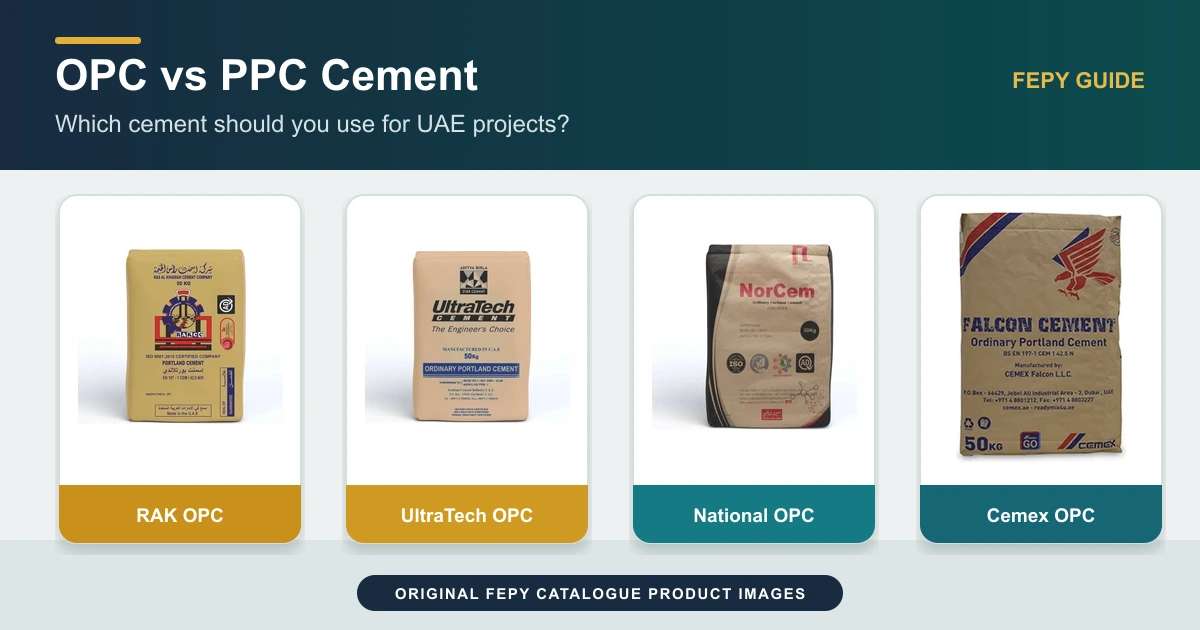
For current listings, use FEPY’s cement and concrete category. At the time of checking, the live category displayed OPC and other cement types from RAK Cement, UltraTech Cement and National Cement. Product selection changes, so confirm that the listing explicitly states OPC, PPC or another required type before ordering.
For wider buying context without relying on a fixed figure, see the related cement price UAE guide.
Which to choose by application
Reinforced concrete frames
Both OPC and PPC can be used in structural concrete when included in an approved mix that meets the design. OPC may suit a programme that requires verified early strength. PPC may suit a programme that allows gradual gain and prioritises durability. The structural engineer’s specification and trial-mix results decide.
Verdict: OPC for early-cycle priorities; PPC for durability-led mixes where the schedule allows. No automatic winner.
Foundations and below-ground work
Foundations can face heat buildup in larger pours and exposure to site-specific ground conditions. PPC may be attractive for gradual heat development and low-permeability mix design. OPC may also be appropriate with the required cement system, admixtures and thermal controls.
Verdict: PPC is often a strong candidate for larger durability-led foundation pours; OPC remains suitable where the approved design calls for it.
Precast concrete
Precast production often values early demoulding and repeatable cycles. OPC can be a practical choice when the approved mix delivers the required early strength. PPC may be used when the production process is designed around its strength profile.
Verdict: OPC is commonly best for production speed; PPC can suit precast work when the curing and cycle are designed accordingly.
Plastering and masonry work
For people asking which cement is better for plastering, both may be used in a properly proportioned, approved mortar. PPC is often preferred for workable plaster and a more gradual reaction, while OPC may be chosen where availability and earlier strength are priorities.
Plaster performance also depends on sand grading, substrate preparation, water control, coat thickness, workmanship and curing. Using more cement does not automatically produce better plaster and can increase shrinkage risk.
Verdict: PPC can be a useful plastering choice where workability and gradual gain are desired; OPC is suitable when the specified mortar and site method support it.
Blockwork mortar
OPC and PPC can both serve suitable mortar mixes. Select according to the masonry specification rather than using structural-concrete proportions by habit. Consistency, joint filling and curing influence the finished wall.
Verdict: choose the cement named in the approved mortar mix; neither type wins by default.
Repairs and time-sensitive work
When a repair must reach a verified strength quickly, OPC may be considered. The repair product or engineered repair system still controls the selection. A general OPC bag is not a substitute for a specified repair material.
Verdict: OPC is often the better candidate for suitable early-strength work, subject to the repair specification.
Mass concrete and large pours
PPC is often considered where reducing and managing heat development is important. Concrete temperature monitoring, pour planning and curing are still required. For OPC, an engineered thermal plan can also make the mix suitable.
Verdict: PPC is often best for heat-control priorities; OPC can work when the complete design demonstrates suitability.
Simple selection checklist
Before ordering, confirm:
- The project specification and approved cement type
- Required early and later-age strengths
- Exposure and durability requirements
- Element size and thermal-control needs
- Concrete supplier’s approved mix
- Placement temperature and transport time
- Curing method and duration
- Delivery quantity, storage space and batch traceability
If any of these items are unclear, confirm them with the engineer or concrete supplier before substituting one cement type for another.
Buying cement on FEPY
Browse FEPY’s live cement and concrete range to compare current product types and availability. Read the full title and description: OPC, PPC, Portland limestone cement, masonry cement, white cement and sulphate-resisting products are different choices and should not be treated as interchangeable.
Compare products using the cement type, intended application, package or supply format and the project requirement—not brand or bag colour alone. For a scheduled pour, confirm quantity and delivery arrangements before work begins, and avoid changing the approved cement mid-pour without authorisation.
When the correct product is confirmed, buy online from FEPY with a VAT invoice, UAE delivery and payment by COD or card, subject to current checkout and delivery options. For project orders, prepare the required quantities and delivery sequence so the team can compare suitable products as a complete requirement.

