


Asian Paints Berger Colour Codes — A UAE Shade & Buying Guide
Choosing paint in the UAE involves more than finding an attractive colour on a phone screen. Bright daylight, warm artificial lighting, dust, strong exterior sun and the sheen of the selected coating can all change how a shade appears. The safest buying process is therefore code-led but sample-confirmed: use the official catalogue to identify candidates, match the code to the correct product family and finish, and test the system on the actual surface.
The official Asian Paints Arabia colour catalogue provides shade cards, colour families, combinations and visualisation tools. Asian Paints Arabia also states that its palette contains more than 1,800 shades. That breadth is useful, but it makes exact identification essential. A colour name alone is not enough when two products, bases or finishes may render a similar colour differently.
How Asian Paints Berger colour codes work
A shade code is an identifier used to distinguish a colour within a manufacturer’s system or a specific product listing. The code is more reliable than a casual description such as “warm white” or “medium grey,” but it must be read with the complete product information.
Before placing an order, record all of the following:
- Brand: Asian Paints Berger.
- Product range: for example, Select Eggshell or All In One Enamel.
- Shade code and shade name.
- Finish: matt, silk, gloss, textured or another stated finish.
- Pack size.
- Intended substrate and whether the product is for interior or exterior use.
- Batch information when colour continuity across a large project is important.
This prevents a common error: ordering the right colour code in the wrong coating. A wall emulsion and a high-gloss enamel may use similar shade language but serve different surfaces and produce different visual results. The substrate, primer, application method and sheen also influence the final appearance.
Verified colour codes found in current FEPY listings
The following examples are grounded in active FEPY catalogue products. They are examples of purchasable variants, not a claim that these are the only available Asian Paints Berger colours.
| Code | Listed shade | Example product and use |
|---|---|---|
| 800 | White | Select Eggshell emulsions and All In One Enamel variants |
| 801 | Off White | Select Eggshell emulsions and All In One Enamel variants |
| 293 | Silver Grey | All In One Enamel for suitable prepared surfaces |
| 294 | Flake Grey | All In One Enamel |
| 295 | Minerva Grey | All In One Enamel |
| 315 | Coffee | All In One Enamel |
| 345 | Lemon | All In One Enamel |
| 348 | Golden Yellow | All In One Enamel |
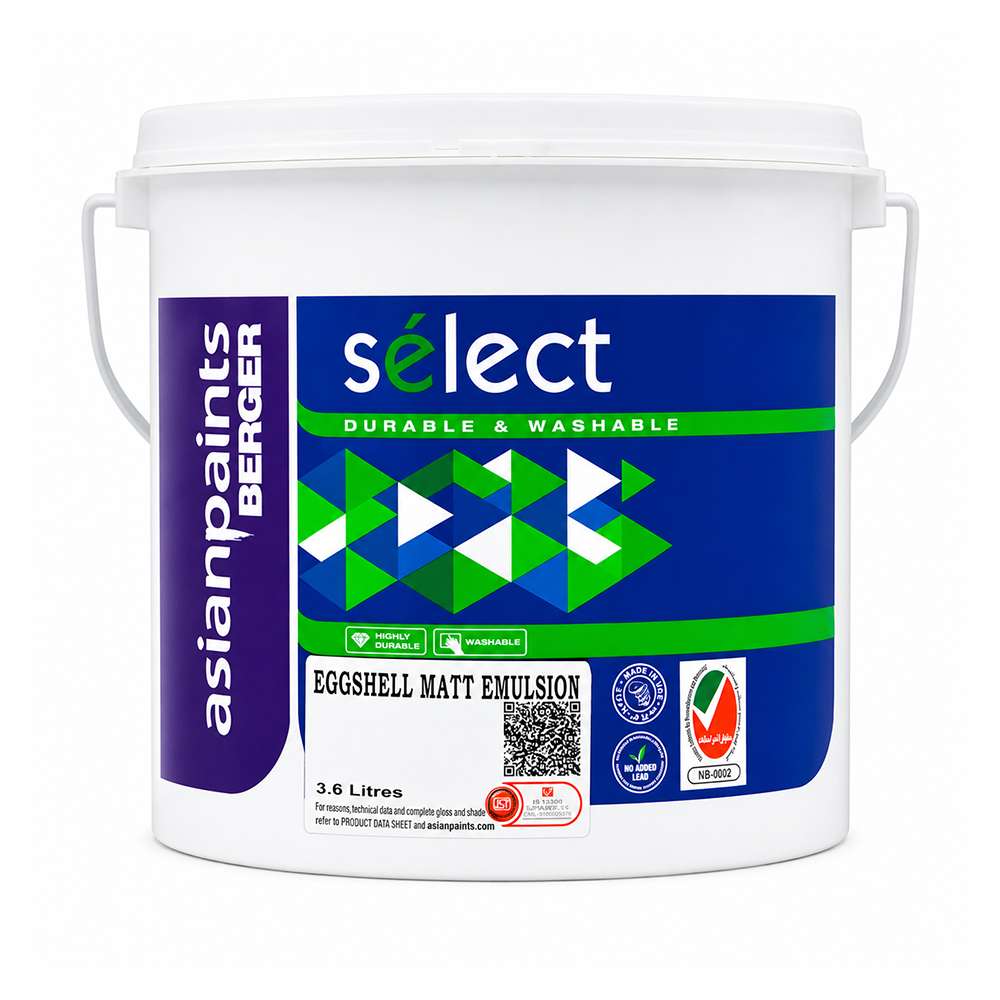
For an interior white with a lower-sheen appearance, FEPY lists Asian Paints Berger Select Eggshell Matt Emulsion 800 White, 3.6L. For a softer neutral, the Select Eggshell Matt Emulsion 801 Off White, 3.6L is a separate coded variant.
Where a silk finish is preferred, the equivalent family must still be identified in full. FEPY lists Asian Paints Berger Select Eggshell Silk Emulsion 800 White, 3.6L and Select Eggshell Silk Emulsion 801 Off White, 3.6L. Although the colour code is familiar, the silk and matt variants should not be treated as visually identical under all lighting because sheen changes reflected light.
For doors, trims or compatible prepared metal and wood surfaces, an enamel product may be appropriate. One example is Asian Paints Berger All In One Enamel 293 Silver Grey, 3.6L. Always check the product page and manufacturer instructions for substrate preparation, primer compatibility and application guidance.
White versus off-white in UAE interiors
White 800 and Off White 801 are useful starting points, but their effect depends on the room. A clean white can make compact spaces feel brighter and can provide strong contrast with darker joinery. Off-white can soften glare and often works well with beige flooring, warm timber and cream-coloured furnishings.
In the UAE, rooms receive very different light depending on orientation, glazing and surrounding buildings. A shade viewed in a showroom may look warmer or cooler at home. Test both options on at least two walls and examine them in morning daylight, afternoon light and the artificial lighting used at night.
Finish matters as much as shade. Matt paint tends to diffuse light and can make minor wall irregularities less obvious. Silk or eggshell reflects more light and can give colour greater apparent depth, but it may also make surface defects more visible. The correct choice depends on the desired appearance, expected cleaning and the manufacturer’s suitability guidance.
Choosing greys without an undertone surprise
Silver Grey 293, Flake Grey 294 and Minerva Grey 295 are distinct listed enamel shades. Do not select between them from the names alone. Greys may show blue, green, brown or warm undertones beside stone, tiles, aluminium and timber.
Place a sample next to fixed finishes rather than viewing it in isolation. For exterior metalwork, also inspect the shade in direct sun and shade. Strong UAE daylight can make a mid-grey appear significantly lighter, while a glossy enamel can produce sharp highlights. Where multiple cans are required, confirm identical shade and product information and follow the manufacturer’s recommendations for mixing and application consistency.
Colour codes for feature elements
Coffee 315, Lemon 345 and Golden Yellow 348 are examples of stronger coded enamel colours in the FEPY catalogue. These can work on selected doors, furniture, trims, display elements or decorative metalwork when the product is suitable for the substrate.
Use stronger colours deliberately. A sample panel should be large enough to show the relationship with flooring, stone, tiles and nearby wall colours. A small digital swatch cannot represent gloss, texture or surrounding reflections accurately. For gold and yellow tones especially, the colour of the primer and the number of coats can influence uniformity, so follow the official product system rather than improvising layers from unrelated brands.
A practical shade-selection process
1. Define the surface and environment
Identify whether the project involves interior walls, exterior masonry, wood, steel, doors, trim or a decorative feature. Then determine exposure to direct sun, humidity, cleaning and wear. Product suitability comes before colour.
2. Choose the product family and finish
Select the appropriate Asian Paints Berger range and its stated finish. Do not choose a code first and assume it is available in every product. Check the exact range, shade, size and application guidance.
3. Shortlist through the official catalogue
Use the manufacturer’s catalogue to narrow the colour family. Online tools are helpful for comparison, but screens vary in brightness and colour calibration. Treat digital visualisation as a shortlist tool, not final approval.
4. Verify the physical shade code
Confirm the code on an official shade card, product label or approved sample. Write the full reference into the purchase request: product family, code, shade name, finish and pack size.
5. Prepare a sample panel
Apply the complete recommended system—including surface preparation and primer—to a representative area. Observe it when dry under the lighting conditions that matter. A sample on cardboard may not behave like the actual wall or metal substrate.
6. Calculate quantity and confirm batches
Measure the project area, account for openings and use the manufacturer’s coverage and coat guidance. Coverage varies with surface porosity, texture, application method and colour change. For larger areas, plan the order so material can be checked before application and colour continuity can be managed.
Common buying mistakes to avoid
- Ordering by colour name without the code.
- Using a code without specifying the product range and finish.
- Treating a website swatch as a guaranteed physical colour match.
- Assuming 800 White in matt emulsion will look identical to 800 White in glossy enamel.
- Copying a shade code from an old container without checking the current product label.
- Selecting exterior paint only by colour while ignoring substrate and weather exposure.
- Mixing different products or batches across one uninterrupted surface without checking consistency.
- Skipping the sample panel because the project deadline is short.
Buying Asian Paints Berger products through FEPY
Use the exact FEPY product title and SKU as the commercial reference, then compare its product family, shade code, colour, finish and size with the approved project schedule. Availability and pricing can change, so check the live product page at the time of ordering.
If a required shade is not shown in the active catalogue, do not substitute the nearest colour automatically. Confirm whether tinting, another pack size or an alternative product family is available and obtain approval for any change. For project work, keep the approved sample and purchasing record until painting is complete.


