







By Khalid Al Mansoori, Senior Procurement Specialist | Published: April 2026
Having procured cement across projects in Al Quoz, Mussafah, and the Fujairah coastal belt, I can tell you the single biggest mistake site teams make is purchasing cement based on price alone without accounting for grade suitability, sulphate exposure, or the logistics cost to site. This guide cuts through the noise and gives you a working price reference — bag and bulk — for every major cement type actively used on UAE construction sites right now.
Current Cement Prices in UAE (Dubai, Abu Dhabi & Northern Emirates)
Prices listed below are indicative retail and trade-counter figures for Q2 2026. Bulk pricing, project-volume discounts, and freight surcharges vary by emirate and supplier. All prices are in AED, inclusive of standard 50 kg bag packaging unless stated.
- Dubai & Sharjah: Retail bag prices are generally 2–4% higher than factory-gate owing to last-mile transport.
- Abu Dhabi & Al Ain: Local production from Al Ain Cement keeps OPC pricing competitive; SRC demand is also higher here due to saline groundwater in coastal and desert zones.
- Northern Emirates (RAK, Fujairah, UAQ): Factory-adjacent pricing on RAK Cement products; other brands may carry a small freight premium.
Cement Grades Used in UAE Construction: OPC 42.5, OPC 52.5, SRC & White
OPC 42.5 N / R — General Purpose Cement Pricing
OPC 42.5 is the workhorse grade on most UAE sites — villa slabs, column pours, block-bonding mortar, plastering, and general concrete work all typically specify this grade. At 42.5 MPa minimum 28-day compressive strength [BS EN 197-1], it satisfies the majority of Dubai Municipality and Abu Dhabi Municipal Council structural submissions. Expect to pay AED 14–17 per 50 kg bag at trade counter; bulk tonne pricing (loose or jumbo bag) sits around AED 250–290 per tonne ex-factory or delivered within 50 km.
OPC 52.5 N / R — High-Strength Cement Pricing
OPC 52.5 is specified on high-rise towers, precast elements, post-tensioned slabs, and fast-track commercial fit-out work where early strength gain matters. The 52.5 R (rapid) variant is common in Dubai's tower belt where the formwork cycle is 3–4 days. At AED 17–21 per 50 kg bag retail, the premium over 42.5 is real but justified when you factor in reduced cure time and earlier loading. Bulk: AED 290–340 per tonne.
Sulphate Resistant Cement (SRC) — Coastal & Underground Projects
Sulphate Resistant Cement is non-negotiable for foundations in coastal zones, below-grade basements, and any structure sitting in UAE soils with soluble sulphate content exceeding 0.5 g/litre in groundwater [BS 8500-1 / ACI 318]. Abu Dhabi's coastal corridors, Palm Jumeirah infrastructure, and RAK's sabkha zones all commonly mandate SRC on engineer's drawings. Pricing: AED 16–20 per 50 kg bag; bulk AED 285–330 per tonne. The marginal cost over OPC is a fraction of remediation costs if sulphate attack compromises a foundation.
White Cement — Finishing, Jointing & Decorative Work
White cement is used for tile jointing, exposed architectural features, exterior render finishing, terrazzo, and where pigmented concrete or a clean white base is specified. It carries a significant premium over grey OPC because of the pure limestone and kaolin raw material requirements, plus the energy-intensive bleaching process. Expect AED 28–40 per 50 kg bag depending on brand and grade (White 42.5 vs 52.5). Birla White dominates this segment in the UAE market.
Masonry Cement — Blockwork & Plastering
Masonry cement is a factory-blended product (clinker + filler + air-entraining agent) optimised for brickwork, blockwork bonding, and render coats. It offers better workability and adhesion than straight OPC for non-structural applications and reduces cracking risk on large plaster areas common in UAE villa construction. Price: AED 12–15 per 50 kg bag — the most cost-effective bagged cement option for plastering gangs.
Major Cement Brands Available in the UAE Market
Local UAE Manufacturers
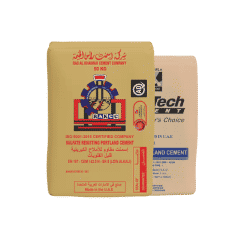
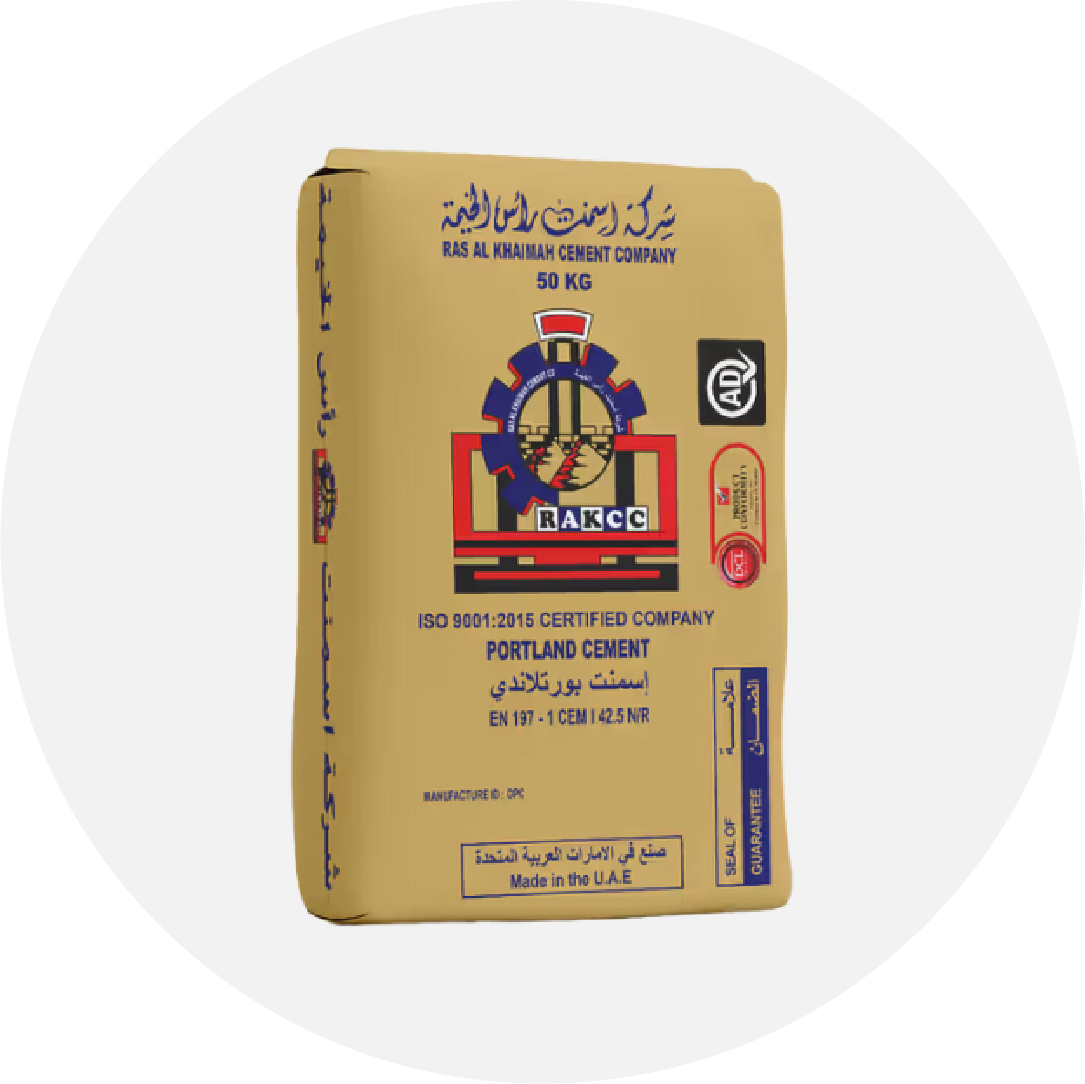
- RAK Cement — Ras Al Khaimah-based, one of the largest producers in the GCC. Produces OPC 42.5, OPC 52.5, SRC, and white cement. Strong distribution across all seven emirates.
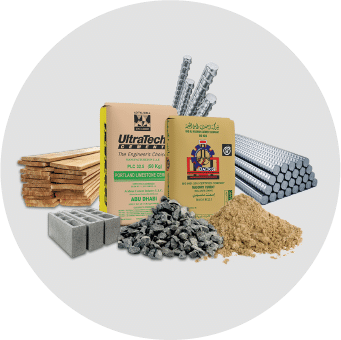
- UltraTech Cement — India's largest cement producer; available in UAE through importers for both OPC and specialty grades. A reliable choice where Indian-origin cement is approved in the project spec.
- Birla White — The dominant white cement brand in the UAE and wider GCC. Consistent quality for architectural finishing work.
- Lafarge (Holcim) — European-heritage multinational; specified on premium projects and international contracts where global brand approval is required.
- Ciment Fondu / Kerneos — Calcium aluminate cement for refractory and high-temperature applications (industrial projects, chimney linings); specialist import only.
Cement Price Comparison Table: Grade vs Brand vs Format
| Grade / Type | Common Brand(s) | Pack Size | Price per Bag (AED) | Bulk per Tonne (AED) | Primary Use |
|---|---|---|---|---|---|
| OPC 42.5 N | RAK Cement, National Cement, Al Ain Cement | 50 kg | 14 – 17 | 250 – 280 | General concrete, slabs, columns |
| OPC 42.5 R | RAK Cement, Emirates Cement | 50 kg | 15 – 18 | 260 – 290 | Fast-track pours, precast |
| OPC 52.5 N | RAK Cement, Lafarge, UltraTech | 50 kg | 17 – 20 | 290 – 320 | High-rise, PT slabs, industrial floors |
| OPC 52.5 R | Lafarge, RAK Cement | 50 kg | 19 – 21 | 310 – 340 | Short-cycle formwork, precast panels |
| SRC (Sulphate Resistant) | RAK Cement, National Cement, Al Ain Cement | 50 kg | 16 – 20 | 285 – 330 | Foundations, basements, coastal zones |
| White Cement 42.5 | Birla White, RAK White | 50 kg | 28 – 36 | 550 – 700 | Tile jointing, render, decorative |
| White Cement 52.5 | Birla White | 50 kg | 34 – 40 | 650 – 750 | Architectural concrete, terrazzo |
| Masonry Cement | RAK Cement, Emirates Cement | 50 kg | 12 – 15 | 220 – 260 | Blockwork bonding, plastering |
| PLC (Portland Limestone) | RAK Cement, Lafarge | 50 kg | 14 – 17 | 240 – 275 | General construction, lower carbon |
Prices are indicative trade-counter figures for Q2 2026. Project-volume and bulk-delivery discounts are negotiable. Prices may vary by emirate and delivery distance.
Which Cement Grade Should You Use for Your Project?
This is the question that actually determines whether your structure performs — and whether your project passes a municipality inspection. Here is a practical guide by project type:
- Villa slab and column concrete (non-coastal inland): OPC 42.5 N or R. Standard 1:2:4 or design mix to C25/30 [BS EN 206].
- High-rise shear walls and core walls: OPC 52.5 R. Early strength allows earlier load transfer and faster cycle times — critical on Dubai tower projects.
- Any below-grade work, pile caps, or raft foundations near the coast: SRC mandatory where sulphate exposure class is XA2 or XA3 [BS 8500-1]. Check your geotechnical report — do not assume.
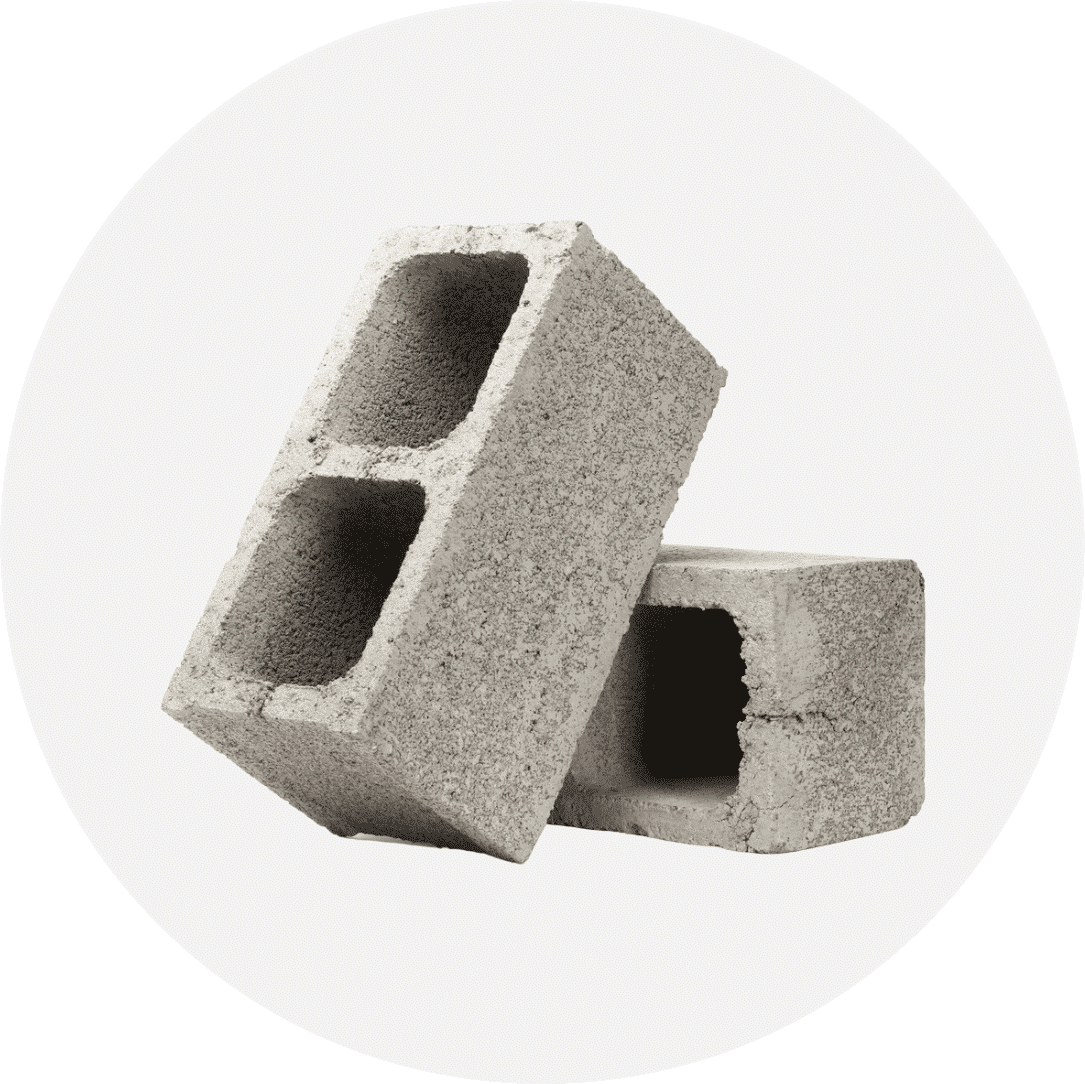
- Block bonding, internal plaster, external render: Masonry cement or OPC 42.5 with a plasticiser admixture. Straight OPC 52.5 on plaster is overkill and increases shrinkage cracking risk.
- Tile grouting, exposed white concrete, terrazzo, decorative columns: White cement — specify Birla White 42.5 for standard jointing, 52.5 for structural white concrete elements.
- Precast units, pipes, drainage products: OPC 52.5 R or SRPC 42.5 depending on exposure class.
Factors That Drive Cement Prices in the UAE
Buying by the Bag vs Bulk Tonne — Cost Breakdown
At retail bag level, you are paying for packaging, palletisation, handling, and last-mile delivery margins. A 50 kg bag at AED 17 equates to AED 340 per tonne — versus AED 260–280 per tonne in bulk loose or jumbo-bag format. For any pour exceeding 50 m³, it is worth pricing bulk supply from a ready-mix supplier or bulk cement depot. The crossover point on a typical Dubai residential project is roughly 10–15 tonnes, beyond which bulk becomes clearly cheaper even after silo hire or jumbo-bag delivery charges.
How UAE's Extreme Heat Affects Cement Selection and Setting Time
At 45–50°C ambient temperatures common across UAE summers, the hydration reaction in cement accelerates significantly. Flash setting is a real risk when mixing OPC 52.5 R in direct sun without ice water or chilled water batching. On summer pours, many sites switch to OPC 42.5 N (normal) for its slower initial set, add retarder admixtures, and schedule pours for pre-dawn hours. This also affects bag storage — cement stored in direct sun or poorly ventilated warehouses begins to hydrate from atmospheric moisture within weeks, reducing effective strength. Always check bag condition and production date before accepting a delivery.
Price Trends: What's Moved Cement Costs in 2025–2026
UAE cement prices have been shaped by several converging factors: energy cost fluctuations (clinker production is highly energy-intensive), logistics costs from GCC and Indian import routes, and construction activity levels in Dubai (Expo legacy development, the Dubai Urban Master Plan 2040 pipeline) and Abu Dhabi (Zayed City, ADNOC industrial expansions). Local producer prices have remained relatively stable due to overcapacity in UAE and GCC clinker production, but bagged retail prices have seen modest 5–8% increases since early 2025 driven by fuel surcharges on distribution.
Transport, Wastage & Storage — The Hidden Costs on Site
A 50 kg bag of cement nominally produces approximately 0.035 m³ of concrete (at a 1:2:4 mix ratio). Waste from torn bags, improper storage, and over-batching can add 8–12% to your actual cement consumption. Factor this in when ordering. Cement stored on site for more than 90 days in UAE conditions should be tested before use — the combination of fine construction dust, coastal humidity (particularly in Abu Dhabi, Dubai Marina, and the East Coast), and temperature cycling accelerates pre-hydration. Palletise, wrap, and store off-ground in shaded, ventilated areas.
Safety, Standards & Regulatory Compliance for Cement in UAE
All cement supplied and used in the UAE must comply with UAE.S 1, the Emirates standard for Portland cement, which is administered by ESMA (Emirates Authority for Standardisation and Metrology). ESMA certification is a mandatory requirement — suppliers without ESMA-approved products should not be accepted on site. You can verify conformity marks and certification status directly at the ESMA official portal.
In parallel, most UAE engineering specifications (particularly for government and semi-government projects) reference BS EN 197-1 for cement classification and BS 8500-1 for concrete specification — both of which align with the ESMA framework. Dubai Municipality's Green Building Regulations also now encourage or mandate the use of Portland Limestone Cement (PLC) and supplementary cementitious materials (SCMs like GGBS and fly ash) to reduce the embodied carbon of structural concrete on qualifying projects.
For SRC specifically, the sulphate resistance classification must be confirmed by the manufacturer's third-party test certificate, not self-declaration. Any project consultant worth their PI insurance will ask for this before sign-off.
When purchasing cement and concrete materials for structural applications, always request the batch test certificate (mill certificate) with each delivery — it should show 3-day, 7-day, and 28-day compressive strength data, fineness, and setting time conforming to the declared grade.
Where to Buy Cement in UAE
For project quantities — whether you are a main contractor, sub-contractor, or a villa self-builder — sourcing from a reliable, ESMA-verified supplier matters as much as price. Look for suppliers who can provide mill certificates, maintain cold-chain-compliant storage, and offer consistent lead times.
FEPY stocks cement from verified UAE-market brands with full documentation. Browse by grade and brand below:
Sources & References
- ESMA — Emirates Authority for Standardisation and Metrology: UAE.S 1 Cement Standards & Conformity Certification
- BSI Group — BS EN 197-1 Portland Cement Classification & BS 8500-1 Concrete Specification for the UK and UAE Market
- Dubai Municipality — Green Building Regulations & Construction Material Compliance Requirements
