



Tile Adhesive Price in the UAE — Types, Coverage & Rates
The tile adhesive price in the UAE depends on much more than the size of the bag or bucket. Adhesive chemistry, tile type, tile dimensions, substrate, location, working characteristics and coverage all affect the real cost of an installation. A lower-priced product can cost more overall if it needs a thicker bed, gives poor coverage for the application or is not suitable for the tile and surface.
There is no single tile bond price that applies to every job, and fixed figures quickly become outdated. The most reliable approach is to compare current products in FEPY’s tile fixing & grouting category, check each product’s intended use and calculate the required quantity from its published coverage guidance.
This guide explains the main types, the variables that change coverage and how to choose for floor, wall, wet-area and large-format installations without treating one adhesive as universally best.
Quick answer: tile adhesive price and types
Tile adhesive cost varies by product type and performance. General-purpose cement-based products are often considered for routine ceramic wall and floor work. Improved, flexible, rapid-setting, lightweight, polyurethane or epoxy products are more specialised and can sit in a different price band. Ready-mixed products may be convenient for suitable wall applications, but their use and drying behaviour differ from cement-based powder.
| Adhesive type | Common buying consideration | Typical application decision |
|---|---|---|
| Standard cement-based powder | Often selected for value on suitable routine work | Match it to the tile, substrate, location and product instructions |
| Improved or flexible cement-based adhesive | Added capability can affect the current price | Consider for demanding tiles, substrates or movement conditions when specified |
| Rapid-setting cement-based adhesive | Programme speed can be more important than bag price | Useful where the selected product’s faster return-to-service profile is required |
| Lightweight adhesive | Coverage and handling may differ from conventional powder | Consider where the manufacturer states suitability for the tile format and substrate |
| Ready-mixed adhesive | Convenience and no on-site powder mixing | Usually assessed for appropriate wall and internal applications; verify limitations |
| Reactive adhesive, such as epoxy or polyurethane | Specialist chemistry generally changes the cost basis | Consider for difficult substrates or demanding exposure only when the product is specified |
Price verdict: do not compare bags or buckets by price alone. Compare adhesive type, package size, calculated coverage, installation conditions and whether the product is suitable for the exact tile and substrate.
For a current tile adhesive UAE comparison, open the live category and review product details rather than relying on a fixed market rate. Promotions, stock, package formats and delivery requirements change.
Cement-based vs ready-mixed
Cement-based tile adhesive
A cement based tile adhesive is normally supplied as a dry powder and mixed according to the product instructions. This category includes general-purpose, improved, flexible, rapid-setting and lightweight products. It is widely used for floor and wall tiling, but individual products are not interchangeable.
The main buying advantages are the range of options and the ability to select a product for the tile, substrate and installation environment. Cement-based systems can suit ceramic, porcelain or stone installations when the selected product explicitly supports them. Some are intended for routine interiors, while others are designed for more demanding locations or tile formats.
Mixing control is essential. Too much or too little water can change workability and performance. Observe the stated mixing method, resting or remixing instructions where applicable, usable working period and application method. Do not add extra water after the mix begins to stiffen unless the manufacturer expressly permits it.
Best for: projects needing a product selected to a defined tile, substrate, floor or wall application, especially when the job calls for a powder adhesive with stated performance for that use.
Ready-mixed tile adhesive
Ready-mixed adhesive is supplied in a usable paste. It can reduce on-site mixing and may be convenient for appropriate internal wall tiling. However, it hardens differently from cement-based powder, and drying can be affected by the tile, substrate, bed thickness and surrounding conditions.
Do not assume that a ready-mixed product is suitable for every floor, non-porous tile, wet area or large-format installation. Check the product instructions carefully. A product that works well for a small ceramic wall tile on a suitable absorbent surface may not be appropriate behind a dense large tile or in a demanding exposure.
Best for: suitable applications where convenience is valuable and the manufacturer confirms compatibility with the wall, tile and environment.
Specialist reactive adhesives
Epoxy and polyurethane adhesives serve specialist requirements. They may be considered for certain difficult substrates, chemical exposure, movement conditions or demanding installations. Their application, mixing and working characteristics can differ significantly from standard cement-based products.
The higher product cost may be justified when the project genuinely needs that chemistry. It is not automatically better value for routine work. Confirm substrate preparation, application method and installer capability before ordering.
Best for: specified specialist conditions that cannot be addressed reliably by an appropriate conventional product.
Coverage and how much you need
Coverage is the link between the package price and the actual installed cost. Two bags at similar prices may cover different areas because of product density, tile profile, trowel choice and bed thickness. A useful comparison therefore looks at estimated cost per installed square metre—not just cost per package.
What changes adhesive coverage?
Coverage depends on:
- Package size and product formulation
- Recommended bed thickness
- Notched-trowel size and application angle
- Flatness of the substrate
- Tile dimensions and back profile
- Whether adhesive is applied to the substrate only or also to the tile back
- Required contact and finished bed after the tile is pressed in
- Waste from mixing, transfer and cleaning
- Installer technique and site conditions
Because these variables are project-specific, a universal “square metres per bag” figure would be misleading. Use the coverage table or calculator provided for the exact product, then allow a sensible project contingency.
A practical quantity calculation
Use this process:
- Measure the net tiled area in square metres.
- Add the areas of returns, upstands, niches and other tiled details.
- Confirm the tile size, back profile and substrate condition.
- Select the adhesive and the application method stated for that combination.
- Find the manufacturer’s published consumption or coverage for the intended trowel and bed.
- Divide the total tiled area by the stated coverage per package.
- Round up to complete packages and add an allowance for waste and site conditions.
For example, if the selected product documentation provides a coverage value for the project’s application method, divide the measured area by that value. Do not transfer the coverage figure from a different adhesive, package or trowel.
Trowel size and installed bed
A larger notch generally deposits more adhesive before the tile is pressed into position, which reduces package coverage. Trowel choice should be based on tile dimensions, tile-back profile, surface flatness and the required contact—not on maximising the number of square metres from a bag.
Hold the trowel consistently and comb adhesive in a way that allows air to escape when the tile is placed. Periodically lift tiles during installation to check contact. Follow the chosen product’s instructions and the project method statement.
Large-format tiles and coverage
Large-format tiles can require a more carefully controlled substrate, appropriate adhesive and application method. More adhesive may be consumed if the substrate is uneven or the tile back needs additional application to achieve the required contact.
Do not use adhesive to correct major substrate irregularities unless the product is explicitly intended for that thickness and use. Levelling the substrate with the correct preparation system can improve consistency and make quantity estimates more reliable.
Waste and contingency
Real sites rarely use the exact theoretical quantity. Mixing residue, trowel waste, small areas and uneven surfaces can increase consumption. The contingency should reflect the job rather than an arbitrary universal percentage. Complex layouts and rough surfaces generally deserve closer review than an open, flat floor.
Store unopened material as instructed and protect powder from moisture. Ordering too much without considering storage and shelf-life information can create avoidable waste.
Choosing adhesive by tile and substrate
The right adhesive is a compatibility decision. Start with the tile, then check the substrate, location and site conditions.
Ceramic tiles
Ceramic tiles can often be installed with a suitable cement-based adhesive, and some wall applications may accept an appropriate ready-mixed product. Tile porosity, size and location still matter. Confirm that the product page or technical information covers the planned use.
Selection priority: a compatible general-purpose product can offer good value for routine ceramic work, provided the substrate and location are supported.
Porcelain tiles
Porcelain is dense and typically requires an adhesive that specifically states suitability for porcelain. Do not choose purely from the phrase “tile adhesive” on the package. Check whether the selected product covers the tile dimensions, floor or wall position, internal or external location and substrate.
Selection priority: documented compatibility and bond performance for dense tiles, not the lowest package price.
Natural stone
Stone can vary in porosity, moisture sensitivity, colour and dimensional stability. The adhesive colour and chemistry may matter for some light-coloured or sensitive materials. Confirm the stone supplier’s requirements and the adhesive manufacturer’s suitability statement.
Selection priority: stone compatibility, colour considerations and the approved installation system.
Large-format tiles
Large-format installations need close attention to substrate flatness, adhesive deformability where required, open time, contact and handling. Select a product whose instructions cover the tile format and location. Lightweight or improved cement-based options may be considered where their published use matches the project.
Selection priority: a product and method designed for the tile size and substrate—not simply a thicker layer of routine adhesive.
Concrete and cement-based substrates
New or existing cement-based surfaces must be sound, clean and appropriately prepared. Construction residue, laitance, curing compounds, dust or weak material can interfere with adhesion. Moisture condition and the substrate’s maturity should be checked in accordance with the project and product instructions.
Selection priority: preparation first, followed by a compatible adhesive for the exposure and tile.
Existing tiles and difficult surfaces
Tiling over existing finishes may require mechanical preparation, cleaning, priming or a specialist adhesive. The existing surface must be securely bonded; adhesive cannot compensate for a loose base.
Selection priority: verify the whole system—existing finish, preparation, primer where required and adhesive—before work begins.
Bathrooms and wet areas
Tile adhesive is not automatically the waterproofing layer. Bathrooms may require a separate, compatible waterproofing system beneath the tiles. The adhesive must suit the wet-area installation and be compatible with the waterproofed substrate.
Consider floors, walls, shower zones, water exposure, falls and movement details separately. Ready-mixed products may have wet-area or tile-size restrictions, so do not substitute them for a specified cement-based or reactive product without confirmation.
Selection priority: a coordinated waterproofing, adhesive, grout and sealant system suitable for the exact bathroom zone.
External UAE conditions
External tiling in the UAE can face high surface temperatures and thermal movement. Installation timing, substrate temperature, shading, open time and curing conditions deserve attention. Use an adhesive that explicitly supports the external application, tile and substrate.
Do not spread more adhesive than can be tiled within the product’s workable application window. Hot or windy conditions can shorten the practical time available on the substrate.
Stocked brands
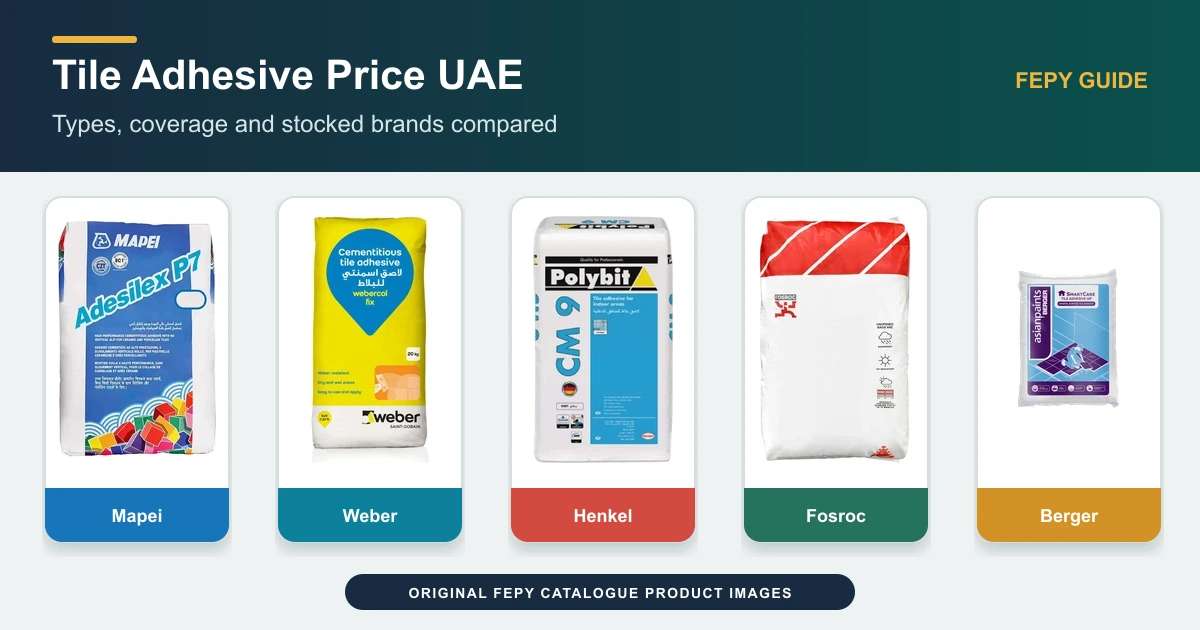
FEPY’s live range includes tile-adhesive products from Mapei, Weber (Sodamco), Henkel, Fosroc and Asian Paints Berger. Availability changes, so compare current listings and confirm the exact application rather than assuming every product from a brand has the same use.
Mapei
Mapei listings include cement-based, lightweight, rapid-setting and specialist tile-adhesive options. The range can help buyers compare products for ceramic, porcelain, stone, floors, walls and demanding substrates. Use the live Mapei brand page and read the individual product details before selecting.
Best for: buyers who want to compare multiple adhesive technologies and application profiles within one stocked brand.
Weber (Sodamco)
Weber (Sodamco) is one of the most widely stocked tile-adhesive brands in the category — including Webercol Fix cementitious tile adhesive for ceramic wall and floor tiles, alongside Weberjoint tile grouts. Compare the exact product, package and intended application on the live listing before selecting.
Best for: buyers comparing widely available, value-focused cementitious tile adhesives and grouts.
Henkel
Henkel tile-adhesive listings include cementitious options under its construction-chemical ranges. Compare the specific product’s supported tile, substrate and location; model names alone do not establish suitability.
Best for: projects where a listed Henkel product directly matches the approved tiling application.
Fosroc
Fosroc listings include tile-adhesive products for construction applications. Check current availability and the exact product description, package and intended use. Do not transfer performance assumptions from another Fosroc construction chemical.
Best for: buyers matching a specific stocked Fosroc adhesive to project requirements.
Asian Paints Berger
Asian Paints Berger listings include SmartCare tile-adhesive products in different variants. Compare the live description and intended application, including tile, surface and wet-area requirements where relevant.
Best for: buyers comparing stocked general-purpose and application-focused options from the SmartCare range.
There is no overall brand winner. The best choice is the exact product that supports the tile, substrate, location and installation method at an acceptable current delivered cost.
Buying tile adhesive on FEPY
Browse FEPY’s live tile fixing & grouting category to compare current tile-adhesive products, package formats and availability. Use filters and product descriptions to narrow the options, but verify suitability before ordering.
Prepare these details first:
- Total tiled area
- Tile material and dimensions
- Wall or floor application
- Internal, external or wet-area location
- Substrate type and condition
- Required bed and trowel method
- Project timing and any rapid-setting need
- Product coverage for that application
- Delivery sequence and on-site storage
For Mapei options, open the linked Mapei range and compare products using their current descriptions. For Henkel, Weber (Sodamco), Fosroc and Asian Paints Berger, use the category listings and search to confirm current stock.
Once the specified product and quantity are confirmed, buy online from FEPY with a VAT invoice, UAE delivery and payment by COD or card, subject to the options available at checkout. Comparing suitability and coverage before purchase is more reliable than choosing by bag price alone.
