














By Khalid Al Mansoori, Senior Procurement Specialist | Published: April 2026
Having sourced access equipment for fit-out and MEP projects across Dubai Marina, Business Bay, and Abu Dhabi's commercial corridors, I've watched supervisors approve the wrong ladder type for a task more often than any other equipment error on site. A painter reaching for an extension ladder on a polished marble floor, an electrician using an aluminium ladder next to a live panel, a warehouse team propping an A-frame against racking — these are not rare. They happen daily across UAE sites, and the consequences range from a dropped tool to a fatality. This guide cuts through the noise and gives you the right framework to select, specify, and procure ladders for every job context you'll encounter in the UAE market.
Why Ladder Selection Matters on UAE Construction Sites
UAE construction timelines are aggressive. Villa renovations in Jumeirah, high-rise MEP fit-outs in DIFC, hotel refurbishments in Yas Island — every project demands rapid access at varied heights, often under time pressure. That pressure is where wrong ladder choices get made. A ladder that's too short forces overreaching; one that's too heavy slows down a two-man team; one made of the wrong material creates an electrocution risk or corrodes within a season in a coastal environment. Getting the selection right isn't pedantic — it's the difference between productive work and a recordable incident.
Types of Ladders Used in UAE Construction and Trade
Step Ladders: Best Uses and Configurations
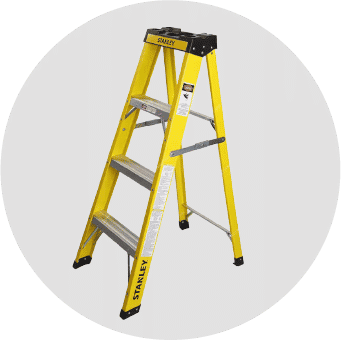
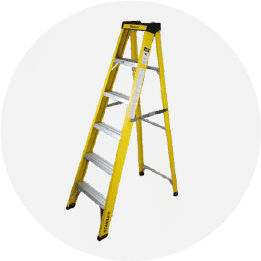
The step ladder — or A-frame ladder — is the most common ladder on UAE interior sites. It's self-supporting, meaning it needs no wall or structure to lean against, which makes it ideal for open floor areas: tiling work, false ceiling installation, light fitting changes, MEP rough-in above suspended ceilings, and painting in villas and apartments. Standard heights range from 3 to 6 steps (roughly 0.9 m to 1.8 m working height). For commercial fit-out with 3-metre ceiling heights, a 6-step or 7-step aluminium step ladder is the standard workhorse. Look for wide-flare legs with rubber feet — particularly important on the polished concrete and marble floors common in UAE commercial builds. Browse the full range of step ladders available in the UAE to compare heights and load ratings before purchasing.
Extension Ladders: Reach, Overlap, and Setup Rules
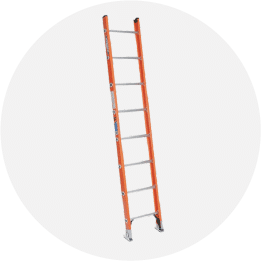
Extension ladders — also called straight or lean-to ladders — are the go-to for external facade work, roof access, and any task requiring reach beyond 4 metres. They consist of two or more interlocking sections that slide apart to the required length. In the UAE context, 6-metre and 8-metre two-section aluminium extension ladders are the most commonly specified for villa maintenance and low-rise external work. The critical rule: the overlap between sections must be at least 1 metre for ladders up to 5 metres extended, and 1.5 metres for ladders over 5 metres [EN 131-1:2015]. Set-up angle must be maintained at 75° (the 1-in-4 rule — 1 metre out for every 4 metres of height). Never use an extension ladder on soft desert sand without a foot plate or drive-in spike. Explore straight and extension ladders suited for UAE site conditions.
Telescopic Ladders: Compact Storage for Urban Sites
Telescopic ladders collapse section-by-section to a compact length — often under 1 metre — making them the practical choice for urban fit-out teams working out of vans or pickups in congested areas like Downtown Dubai, Al Quoz industrial, or Sharjah's commercial zones. They extend from roughly 2.5 m to 4.7 m depending on the model. The trade-off: telescopic ladders have lower load ratings (typically Class II, rated to 150 kg [EN 131-6:2018]) and the rung-locking mechanisms require more frequent inspection than fixed-rung ladders. Ensure every section locks positively before stepping on the ladder. Never partially extend — each section must be either fully locked open or fully closed.
Multi-Purpose / Combination Ladders
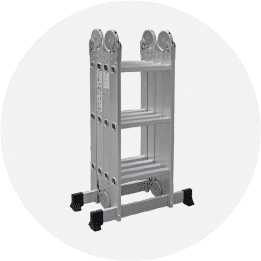
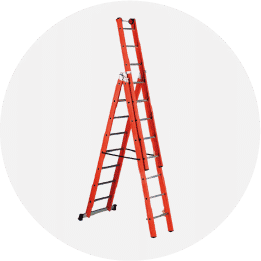
A multi-purpose ladder can configure as an A-frame step ladder, a straight lean-to extension ladder, a staircase ladder (with one side shorter than the other for working on steps), and sometimes a scaffold base. For MEP contractors and fit-out teams who need one ladder to do everything across a mixed-use tower project, a quality multi-purpose model significantly reduces equipment costs and van payload. The hinges and locking pins are the critical failure points — specify ladders where all pivot joints carry an audible and tactile click-lock confirmation. See the multi-purpose ladders category for UAE-available configurations and load specifications.
Platform Ladders for Sustained Working at Height
When a worker needs to stand in one position for an extended period — plastering a wall, installing cable trays, hanging ductwork — a standard step ladder becomes a safety and fatigue liability. A platform ladder solves this by providing a large, guarded standing platform at the top, often with a handrail. Platform ladders are standard specification on Abu Dhabi infrastructure projects and required by many main contractors for any task exceeding 20 minutes at height. They're heavier and slower to reposition but reduce the risk of loss of balance during sustained tasks dramatically. The platform ladder range includes options from 1 m to 2 m platform heights.
Roof and Loft Ladders for Residential Projects
UAE villas — particularly older builds in Mirdif, Meadows, and Jumeirah — regularly require loft access for AC duct maintenance, water tank inspection, and attic storage. Loft ladders are folding or sliding systems designed to fit through a ceiling hatch, typically 55 cm × 110 cm or 60 cm × 120 cm openings. Roof ladders, distinct from loft ladders, are hook-over designs that grip a ridge or parapet and distribute weight across multiple roof tiles or waterproof membranes — essential for solar panel installers and waterproofing contractors working on villa roofs.
Trestle Ladders for Plastering and Ceiling Work
A trestle ladder (or builder's trestle) is a wide, heavy-duty A-frame designed to support scaffold planks between two trestles, creating a temporary work platform at a consistent height. Plastering teams, ceiling contractors, and decorators use trestle systems across wide floor areas where rolling scaffold towers would be overkill. They're a cost-effective access solution for UAE villa interiors during finishing stages.
Scaffolding Ladders and Access Within Scaffold Towers
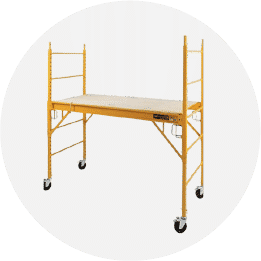
For large-scale external or internal work, a mobile scaffold tower with an integrated access ladder becomes the appropriate solution — not a leaning ladder at all. Scaffold towers provide a fully guarded working platform, tool storage, and the ability to work at heights exceeding 6 metres safely. Many Dubai Municipality-approved construction site safety plans require scaffold towers for any sustained work above 3 metres on public-facing facades. View the scaffolding ladder and access tower range for specifications.
Aluminium vs Fibreglass Ladders: Which Is Right for Your UAE Job?
| Factor | Aluminium Ladder | Fibreglass Ladder |
|---|---|---|
| Weight | Lighter — easier to carry on site | 30–40% heavier than equivalent aluminium |
| Electrical safety | CONDUCTIVE — never use near live electrical panels or overhead lines | NON-CONDUCTIVE — mandatory for electrical work [IEC 60900] |
| Heat resistance | Retains structural integrity but becomes hot to the touch in UAE sun (surface temps 60°C+) | Better UV resistance; does not heat as rapidly |
| Corrosion resistance | Aluminium oxidises and pits in coastal/salt-air environments over time | Fully corrosion-resistant — better for coastal UAE projects |
| Cost (AED) | Lower — typically AED 150–900 for standard step/extension models | Higher — typically AED 400–2,500 depending on height and load class |
| Best for | General construction, interiors, non-electrical tasks | MEP/electrical work, outdoor coastal sites, any proximity to live circuits |
Rule of thumb: If there is any possibility of electrical contact — even indirect — specify fibreglass. For all other trades on typical UAE interior or external construction sites, aluminium is the standard, practical choice.
Ladder Load Ratings and Safety Standards in the UAE
Load Class I, II, and III: What the Numbers Mean
EN 131 classifies ladders into professional (formerly Class I) and non-professional (formerly Class II) categories [EN 131-1:2015], but the more practical breakdown for UAE site procurement is by maximum load rating:
- 150 kg rated (Class II / Light Professional): Suitable for light trade tasks — painters, decorators, minor MEP. Covers most individual workers with a standard tool belt.
- 175 kg rated (Class I / Professional): Standard for UAE construction and fit-out sites. Covers a heavy worker with full PPE, tool bag, and materials in hand.
- 200 kg+ rated (Heavy Industrial): Required for heavy MEP, industrial maintenance, and any application where the worker carries significant equipment load.
Always specify the load rating in your procurement brief. A 150 kg-rated ladder purchased to save AED 80 becomes a liability the moment a site supervisor climbs it wearing full PPE with a cable reel over his shoulder.
EN 131 Certification: What UAE Sites Should Demand
EN 131 is the primary European ladder standard widely adopted as the benchmark for UAE site acceptance [EN 131-1:2015, EN 131-2:2017]. It covers dimensional requirements, strength testing, slip resistance of rungs, and marking requirements. Main contractors on Dubai and Abu Dhabi projects — particularly those operating under Tier 1 HSE frameworks — routinely require EN 131 certification on all ladders procured for site use. OSHA (US standard, 29 CFR 1926.1053) is also referenced on some international-JV sites in the UAE but EN 131 is the dominant requirement. Check the certification mark on the ladder stile before purchasing — it should be stamped or permanently labelled, not on a removable sticker.
Choosing the Right Ladder Height for Your Application
| Task / Application | Recommended Ladder Type | Suggested Height |
|---|---|---|
| Changing ceiling light fittings (standard villa, 2.8–3 m ceiling) | Step ladder (A-frame) | 6–7 step / 1.8 m |
| Installing false ceiling grid (commercial, 3–3.5 m) | Step ladder or platform ladder | 7–8 step / 2–2.4 m |
| External wall painting, villa (up to 5 m) | Extension / straight ladder | 5–6 m extended |
| Roof access, villa parapet (4–6 m) | Extension ladder or roof ladder | 6–8 m |
| MEP cable tray installation, high-rise fit-out (4–6 m) | Platform ladder or scaffold tower | Platform at 2–3 m |
| Warehouse racking access (up to 6 m) | Rolling / mobile ladder with guard | As per racking height |
| Loft / AC attic access (villa) | Loft ladder (folding) | To match ceiling height |
| Facade / external cladding (6 m+) | Mobile scaffold tower | Platform height per task |
The maximum comfortable working height rule: Add approximately 1 metre to a person's standing height to get their maximum safe reaching height. A person standing at 1.75 m reaches approximately 2.75 m. To work at 3.5 m ceiling height, they need a ladder that puts their feet at roughly 2.5 m — which means a 7-step or 8-step model.
UAE Climate Considerations: Heat, Dust, and Corrosion
How UAE Heat Affects Aluminium Ladder Stability
Aluminium exposed to direct UAE summer sun — particularly on unshaded sites in Sharjah, Al Ain, or Mussafah — can reach surface temperatures of 60–70°C. While this does not structurally compromise the ladder (aluminium retains load-bearing integrity to significantly higher temperatures), it creates a burn-risk to bare hands on rungs and stiles. Site teams working outdoors between June and September should store ladders horizontally in shaded locations, use gloves when handling, and consider rubber rung covers on ladders stored in direct sun. Never leave aluminium ladders strapped vertically to vehicle roofs in peak summer — thermal expansion at joints can deform slide mechanisms on extension and telescopic models.
Anti-Corrosion Features for Coastal and Humid Environments
UAE coastal sites — Palm Jumeirah, Saadiyat Island, the entire Abu Dhabi corniche corridor, Ras Al Khaimah's beachfront developments — expose aluminium to salt-laden air and periodic humidity spikes. Salt air accelerates pitting corrosion on untreated aluminium, particularly at the joints and foot caps where standing water accumulates. For these environments: (1) specify ladders with anodised or powder-coated aluminium stiles, (2) inspect foot caps and rung ends every 3 months and replace when pitting is visible, (3) rinse ladders stored on coastal sites with fresh water weekly, or switch to fibreglass. Check foot condition — a degraded rubber foot on a salt-pitted base rail is the most common cause of ladder slippage on UAE sites.
Fine Dust and Sand: The Hidden Risk
UAE fine dust infiltrates telescopic and extension ladder locking mechanisms. A rung-lock button or sliding collar clogged with construction dust may appear to engage but fails under load. After any dusty site day — desert groundwork, concrete cutting, demolition — disassemble and brush clean all locking mechanisms. Never use WD-40 or oil-based lubricants on plastic locking buttons as these attract more dust; use a dry PTFE spray instead.
Safety & Compliance: Ladder Regulations on UAE Sites
Key Ladder Inspection Checklist Before Each Use
- Check all rungs for bending, cracks, or missing anti-slip inserts
- Inspect stiles (side rails) for dents, cracks, or deformation
- Confirm foot caps are present, undamaged, and gripping properly
- Test all locking mechanisms — hinges, rung locks, spreader bars — for positive engagement
- Check for loose, missing, or corroded rivets at rung-to-stile joints
- Verify the load rating label is legible and the ladder is not overloaded
- Confirm the surface is stable and level before erecting
Ladder Angle and Footing: The 1-in-4 Rule on Site
For any leaning ladder, the base must be positioned 1 metre away from the wall for every 4 metres of vertical height — this gives the safe working angle of 75° [EN 131-1:2015]. On UAE sites with sandy or granular soil, drive a ladder spike or use a proprietary ladder foot plate to prevent base kick-out. On smooth finished floors (marble, ceramic, epoxy), use a ladder mat or have a second person foot the ladder throughout use. Dubai Municipality's construction site safety guidelines require leaning ladders to be secured at the top (tied off) for any climb exceeding 3 metres [Dubai Municipality — Construction Site Safety Regulations].
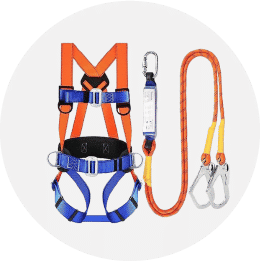
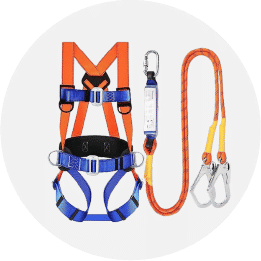
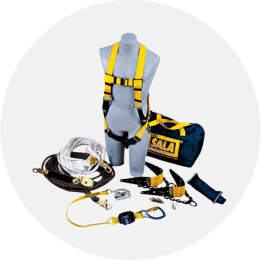
For fall protection equipment used alongside ladder work at height, refer to the fall protection category — harnesses, lanyards, and anchor points are mandatory on most Tier 1 contractor sites in the UAE whenever working above 2 metres.
The EN 131 standard series is the primary benchmark for ladder safety in the UAE market. Full standard documentation is available through BSI Group — EN 131 Ladder Safety Standards.
Top Ladder Brands Available in the UAE Market
| Brand | Origin | Known For | Typical UAE Application |
|---|---|---|---|
| Gazelle | UAE / GCC | Aluminium step and extension ladders, strong GCC distribution | Construction sites, fit-out, general trade |
| Topsafe | International | Safety-focused ladders, platform ladders, EN 131 certified | Industrial, MEP, high-specification site work |
| Vaultex | UAE | Wide PPE and access equipment range, competitive pricing | General contracting, renovation, maintenance |
| Stanley | USA | Trade-grade step and combination ladders, brand recognition | Fit-out, light commercial, villa renovation |
| Topman | International | Multi-purpose and telescopic ladder range | Urban fit-out teams, MEP contractors |
| Würth | Germany | Premium aluminium and fibreglass ladders, industrial-grade hardware | High-end fit-out, industrial facilities, international-JV sites |
| Zarges | Germany | High-spec aluminium and fibreglass, aerospace/industrial heritage | Specialist industrial and offshore applications |
| Louisville Ladder | USA | OSHA-compliant range, fibreglass extension ladders | International-JV sites referencing US standards |
| Little Giant | USA | Multi-position ladders, high load ratings, patented hinge systems | Facilities management, hotel maintenance, fit-out |
| Hailo | Germany | Premium step and platform ladders, European safety pedigree | Commercial fit-out, FM, retail store maintenance |
Where to Buy Ladders in the UAE
For UAE contractors, engineers, and trade buyers, the most efficient procurement route is a specialist building materials and tools platform that carries certified stock with verifiable load ratings and certification documentation. Avoid purchasing ladders from general retail or discount sources where EN 131 certification and load class markings are frequently absent or fraudulent — a concern raised consistently by UAE site safety officers I've spoken with across project cycles.
FEPY stocks a broad range of ladders for UAE construction and trade use, with verified brand sourcing and site-ready specifications. Browse by category:
- Full Ladders & Scaffolding range — all types, all heights
- Step Ladders UAE — A-frame models for interior work
- Platform Ladders UAE — guarded platform models for sustained working at height
- Multi-Purpose Ladders UAE — combination configurations for mixed-task teams
- Combination Ladders UAE — step and extension in one unit
- Rolling Ladders UAE — mobile access for warehouses and racking
- Straight & Extension Ladders UAE — for facade and roof access
- Scaffolding Ladders UAE — integrated scaffold access systems
- Safety Equipment UAE — PPE and site safety products to use alongside ladder work