






By Khalid Al Mansoori, Senior Procurement Specialist | Published: April 2026
Having procured polythene sheeting and tarpaulins for sub-structure packages across villa compounds in Al Barsha and high-rise basement works in Downtown Dubai, I've watched firsthand how the wrong spec — a 125-micron sheet where 300 micron is required, or a non-UV-stabilised tarp left on a south-facing scaffold — turns into a costly rework call within weeks. The UAE's climate is unforgiving on temporary protection materials, and getting the spec right upfront is the difference between a clean handover and a delay notice.
What Are Polythene Sheets and Tarpaulins — and Why UAE Sites Can't Do Without Them
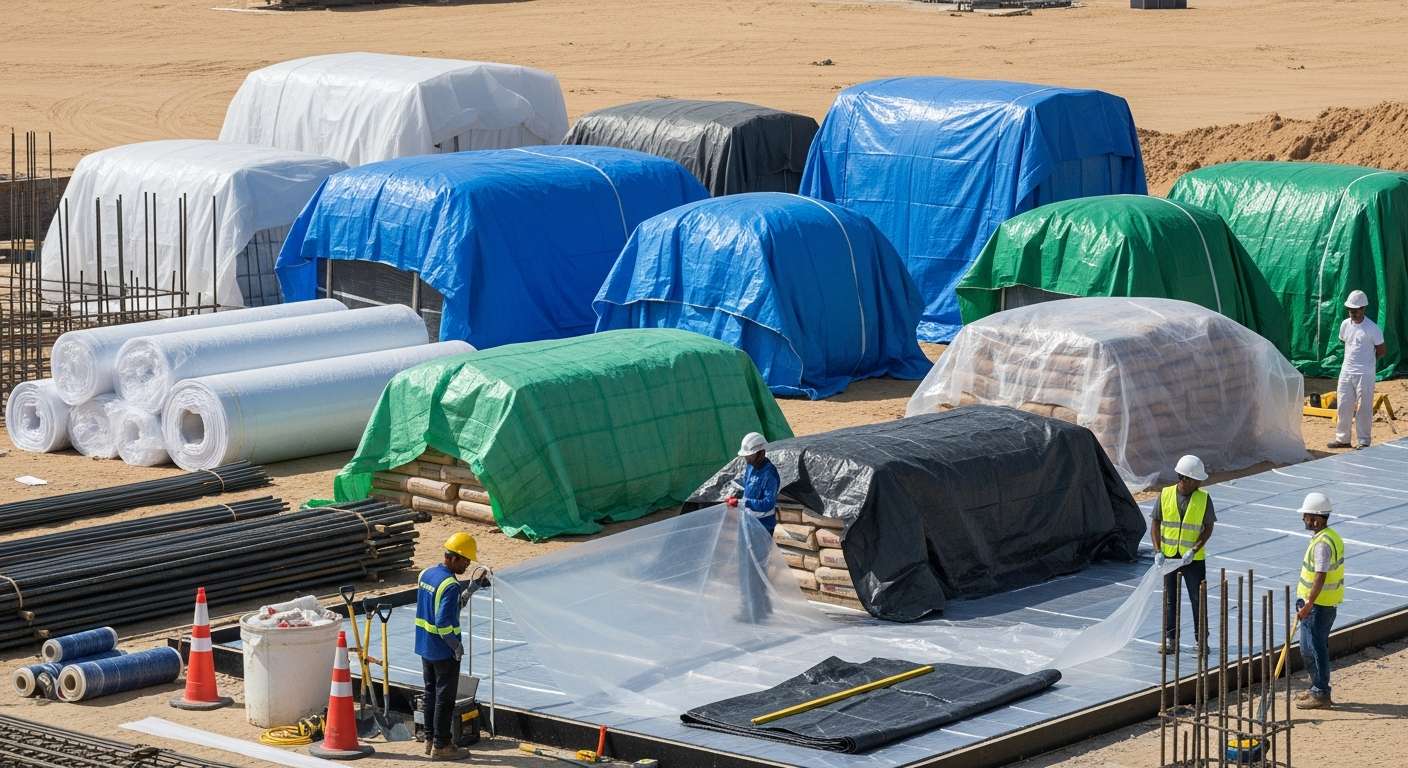
Polythene sheets (polyethylene film) and tarpaulins are among the highest-volume disposable and semi-permanent materials on any UAE construction site. They serve as vapour barriers, damp proof membranes, concrete curing blankets, dust shields, scaffold containment, and equipment covers — often simultaneously on the same project. The two categories are related but serve distinct purposes: polythene sheeting is primarily a film-based moisture or vapour barrier; tarpaulins are reinforced covers engineered for mechanical strength, UV exposure, and load-bearing applications such as debris containment.
Types of Polythene Sheeting Used on UAE Construction Sites
Low-Density Polyethylene (LDPE) Film
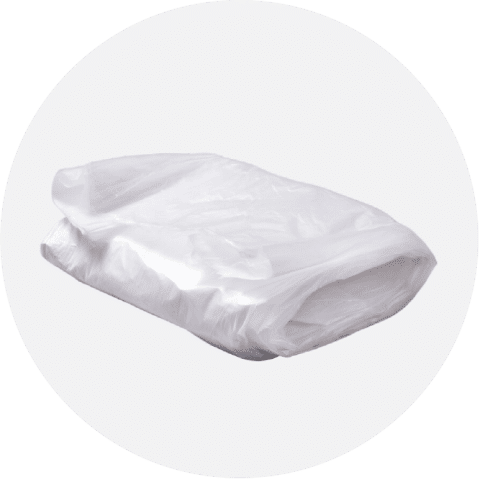
LDPE film is the most common general-purpose poly sheet on site. It is flexible, tear-resistant at low temperatures, and available in rolls from 50 micron (light duty) up to 500 micron (heavy DPM grade). On UAE sites it is used for concrete curing, dust sheeting in fit-out, and short-term equipment protection. LDPE is not inherently UV-stabilised — check the additive spec before exposing to direct sun.
High-Density Polyethylene (HDPE) Sheet
HDPE liners are stiffer, chemically resistant, and suited to sub-structure and geotechnical applications. HDPE geomembrane sheets — typically 0.5 mm to 2.0 mm — are used in basement tanking, landscaping irrigation barriers, and retention pond liners across UAE infrastructure and hospitality projects. They resist puncture from blinding concrete and backfill compaction far better than LDPE.
Linear Low-Density Polyethylene (LLDPE) Stretch Film
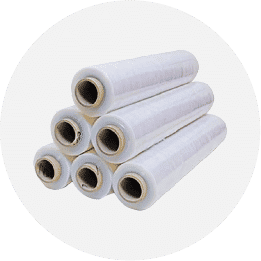
LLDPE is the standard for pallet wrap and material bundling on site. Its higher elongation before failure [ASTM D882] makes it ideal for wrapping irregular shapes — pipe bundles, door frames, MEP equipment — during storage and transit in dusty UAE yards.
Clear vs Black Polythene: When to Use Which
Clear poly film allows light transmission — useful for greenhouse-effect curing of concrete in cooler months. Black polythene blocks light, suppresses weed growth under landscaping, and prevents algae in water-contact applications. For vapour barriers under slabs, black or opaque sheeting is preferred because it also signals clearly that the membrane is in place during inspection. In the UAE's intense sun, black poly absorbs heat rapidly and should not be left exposed at surface level without a covering layer — surface temperatures can reach 70°C+ on a summer afternoon.
Standard Micron Thicknesses and Their Site Applications
| Thickness (Micron) | Typical Application | Durability |
|---|---|---|
| 50–75 µm | Lightweight dust sheets, packing, temporary wrapping | Single-use / light duty |
| 100–125 µm | Concrete curing, short-term floor protection | Short-term reusable |
| 200 µm | Ground cover, vapour barrier (light loads), landscaping | Medium duty |
| 300 µm | DPM under ground-bearing slabs, basement walls | Structural / code-compliant |
| 500 µm+ | Heavy DPM, geotechnical, pond liner (light) | Long-term heavy duty |
Types of Tarpaulins Used in UAE Construction and Outdoor Projects
Woven Polypropylene (PP) Tarpaulins
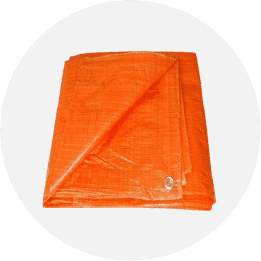
The standard scaffolding and general-cover tarp in the UAE. Woven PP tarps are laminated on both sides with polyethylene, giving them waterproofing, tear resistance, and reasonable UV life (typically 6–18 months depending on UV additive grade). GSM ratings typically run from 60 GSM (lightweight) to 200 GSM (heavy duty site use).
PE-Laminated Woven Tarps
A step up from standard PP — the polyethylene laminate is heavier, the weave tighter, and the reinforced eyelet spacing is closer (typically 0.5–1.0 m centres), which matters on scaffold tying in UAE wind events. These are the go-to for façade containment and scaffold debris sheeting on high-rise work in JLT, Business Bay, and Marina.
Canvas and PVC-Coated Heavy-Duty Tarps
PVC-coated tarps offer superior abrasion resistance and longer service life (3–5 years with proper storage). They are heavier (300–650 GSM), more expensive, and used for permanent or semi-permanent covers — machinery shelters, outdoor storage bays, loading bays. Canvas tarps are rarely used in UAE construction due to moisture retention in humid coastal conditions.
Aluminium Foil Composite Tarps for Heat Reflection
A foil-PE laminated tarp that reflects solar radiation — relevant for covering temperature-sensitive materials (adhesives, sealants, waterproofing membranes) stored on open yards in summer. Surface temperatures under aluminised tarps can be 15–25°C lower than under dark-coloured covers in UAE peak summer conditions.
Scaffold Shrink Wrap and Debris Sheeting
Heat-shrink polyethylene sheeting applied with a heat gun to scaffold frameworks creates a sealed envelope for internal works during fit-out or façade remediation. It is more airtight than standard tarpaulin and increasingly specified on Dubai Municipality-notified projects where dust containment is a permit condition.
Key Technical Specifications to Check Before You Buy
GSM Rating: What It Tells You About Tarp Strength
GSM (grams per square metre) is the primary strength indicator for tarpaulins. Higher GSM = heavier weave = greater tear resistance and longer service life. For scaffold sheeting on UAE sites, a minimum 120 GSM PE-laminated tarp is a reasonable baseline; for long-duration facade containment or debris netting replacement, 180–200 GSM is more appropriate.
UV Stabilisation: Why It Matters at 45°C+
UAE solar irradiance levels are among the highest globally. An unstabilised PP tarp will begin to degrade — losing tensile strength and becoming brittle — within 4–8 weeks of direct sun exposure at summer ambient temperatures of 45–50°C. Specify tarps with HALS (Hindered Amine Light Stabiliser) UV additives and ask suppliers for the rated UV exposure life in hours (e.g. 800 hours, 1,500 hours). Polythene sheeting used as a vapour barrier under slabs is not UV-exposed post-pour, but any sheet left on the surface before concreting must be UV-rated if the slab pour is delayed.
Micron vs GSM: Understanding Both Measurements
Micron measures film thickness (polythene sheets). GSM measures areal weight (tarpaulins and woven materials). They are not interchangeable. A 200-micron polythene sheet weighs approximately 180–200 GSM depending on density, but a 200 GSM tarpaulin is a reinforced woven structure — far stronger mechanically than a plain film of the same weight.
Tear Strength, Elongation, and Puncture Resistance
For DPM applications, puncture resistance is the critical parameter — aggregate in the blinding layer, protruding rebar, and boot traffic are all puncture risks. Test values are typically reported per ASTM D4833 (puncture) and ASTM D1709 (impact resistance). For site procurement, request datasheets and confirm the test method cited matches the application.
UAE Climate Considerations: Heat, UV, Dust, and Coastal Humidity
Salt Air Degradation in Coastal UAE Projects
Projects in Dubai Marina, Palm Jumeirah, Abu Dhabi Corniche, and Ras Al Khaimah coastal zones face accelerated oxidative degradation of polymer sheeting from salt-laden air. This is particularly relevant for tarpaulins used on external storage and scaffolding — chloride ions catalyse polymer chain breakdown. Specify marine-grade UV-stabilised tarps for any project within 500 m of the coastline.
Dust Abrasion on Exposed Sheets
UAE shamal winds carry fine silica-rich dust that acts as a mild abrasive on exposed poly film. On concrete curing operations, a sheet left loose (not weighted or taped) will abrade and develop micro-tears within days during a wind event. Always pin, tape, or weight curing sheets at edges and overlaps.
Thermal Cycling: How Daytime and Night Temperatures Affect Material Life
Summer daytime temperatures of 45–50°C drop to 25–30°C at night — a 20°C diurnal swing. This cycling causes repeated expansion and contraction in any polymer sheet, stressing lap joints and taped seams. Use compatible self-adhesive jointing tape rated for the same temperature range as the sheet itself, especially on DPM laps under slabs.
Applications by Trade: How Each Profession Uses Poly and Tarp
Concrete Curing (Civil and Structural Teams)
Polythene curing sheets retain moisture at the concrete surface, suppressing early-age cracking caused by rapid evaporation in UAE heat. A 125–200 micron clear or white LDPE sheet, laid immediately after finishing and weighted at edges, is standard practice. In peak summer, a curing membrane spray is often applied first, followed by poly sheeting for belt-and-braces moisture retention. The construction chemicals category covers compatible curing compounds.
Temporary Waterproofing and Roof Protection
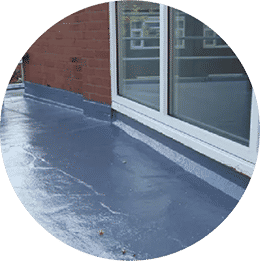
When roof waterproofing works are phased or interrupted, heavy-duty tarpaulins (180–200 GSM, PE-laminated) are used to protect exposed structural slabs from rain — particularly during the November–March UAE rainfall season. Tie-down at parapets and penetration points is critical to prevent uplift in coastal winds.
Basement and Sub-Structure Damp Proofing
A polythene waterproofing membrane laid under ground-bearing slabs prevents ground moisture from migrating into the concrete and reinforcement. This is one of the most technically demanding applications — see the DPM section below for thickness and overlap requirements. Complementary liquid waterproofing products are covered in the wider building materials range.
Scaffold and Façade Containment
Scaffold sheeting serves two purposes in the UAE: dust containment (required under many municipality permits) and weather protection for ongoing works. Woven PP or PE-laminated tarpaulins are fixed to scaffold tubes with eyelets and bungee ties. Fire-retardant variants are required on certain high-rise projects — confirm with your HSE plan before ordering standard grade.
MEP Duct and Equipment Protection
MEP contractors use polythene sheeting to cap ductwork open ends, wrap delivered equipment, and protect installed AHUs during subsequent trades' dusty works. Stretch LLDPE film and 100–125 micron LDPE are standard for this. For thermal insulation wrapping of pipework in exposed plant rooms, an aluminised composite film is sometimes specified as a vapour retarder.
Fit-Out Dust and Floor Protection
Fit-out teams lay drop cloths and sheets over finished floors, joinery, and sanitaryware during snagging and final decoration phases. A 200-micron black or clear poly sheet under a felt-backed cloth is the standard two-layer system for marble and porcelain tile protection on luxury residential projects.
Landscaping and External Works
Black HDPE sheeting is used as a root barrier and weed suppression membrane in UAE landscaping. It must be UV-stabilised if exposed at the surface (before mulch or gravel is placed), and it must be perforated or laid with drainage gaps if used under planting beds. For thermal insulation boards used in external applications, refer to the thermocol sheet category.
Damp Proof Membranes (DPM) — A Separate but Related Category
DPM vs General Poly Sheet: Key Differences
A DPM (damp proof membrane) is a polythene sheet specified and installed as a structural moisture barrier — it is not the same as a general-purpose poly sheet of similar thickness. DPMs must meet BS 8102 (protection of below-ground structures) or equivalent local specification, require controlled overlap and jointing, and must be inspected before concreting commences. General site poly sheeting, even at the same micron rating, may not carry the required certification.
Minimum Thickness Requirements for DPM Under Slabs
The widely referenced industry minimum for a polythene DPM under a ground-bearing slab is 300 microns (1,200 gauge) [BS 8102:2022 / BBA certification requirements]. Some UAE structural consultants specify 500 microns for aggressive ground conditions (saline groundwater, high sulphate soils) which are common in coastal and reclaimed-land zones across Dubai and Abu Dhabi. Always confirm the spec with the structural engineer of record — do not substitute a thinner sheet to save cost. Browse the full range of polythene sheets on FEPY to find DPM-grade options.
Overlap and Sealing Requirements on Site
DPM sheets must be lapped a minimum of 300 mm at all joints [BS 8102:2022], and laps should be taped with compatible jointing tape — not left open. All penetrations (column starters, drainage sleeves) must be sealed with purpose-made collars or self-adhesive flashing tape rated to the same water vapour transmission standard as the membrane. Document all lap positions on an as-built sketch for the handover file.
Major Brands in the UAE Market
| Brand | Product Focus | Origin |
|---|---|---|
| Dubai Polymer | LDPE/HDPE polythene rolls, DPM sheeting, construction film | UAE (local manufacturer) |
| Polytech | Polyethylene sheeting, vapour barrier film, agricultural and construction poly | UAE / GCC |
| National Plastic (NPC) | PE film rolls, construction sheeting | UAE |
| Emmbi Industries | Woven PP tarpaulins, geomembranes, bulk liners | India (widely distributed in UAE) |
| Shur-Line / Plastico | General-purpose poly drop sheets, painter's film | International |
| Agru | HDPE geomembrane liners, DPM for infrastructure | Austria (specified on major UAE infrastructure) |
| Solmax (formerly GSE) | HDPE / LLDPE geomembranes for civil and environmental projects | Canada/International |
| Visqueen | DPM rolls, vapour control layers, radon barriers | UK (specified on mixed-use and hospitality projects) |
How to Choose the Right Product for Your Job
Use this decision framework before raising a purchase order:
- Is it a structural DPM? → Minimum 300 µm, BS 8102-referenced, with jointing tape. Confirm with structural engineer.
- Is it concrete curing? → 125–200 µm LDPE. Clear for solar gain in winter; white or reflective in summer.
- Is it scaffold or facade containment? → Minimum 120 GSM PE-laminated woven tarp. UV-stabilised, fire-retardant if required by HSE plan.
- Is it equipment or floor protection? → 100–200 µm general LDPE or drop cloth. Felt-backed for abrasion protection on finished surfaces.
- Is it a permanent geomembrane? → HDPE liner, 0.5–2.0 mm, installed to GRI GM13 or equivalent, with welded seams.
- Coastal project? → Upgrade UV and salt-resistance spec across all exposed materials.
Safety, Compliance, and UAE Regulatory Standards
Polythene sheeting and tarpaulins used on UAE construction sites must comply with several overlapping frameworks:
- Dubai Municipality building regulations require that moisture barriers and DPMs under slabs meet minimum performance thresholds. Structural consultants must specify the membrane grade in drawings; deviations require RFI approval.
- ESMA (Emirates Authority for Standardisation and Metrology) may apply UAE.S standards to construction plastic products, particularly those marketed with specific performance claims. Check for Emirates Conformity Mark (ECAS) requirements on any product marketed as a certified DPM. See ESMA — Emirates Conformity Assessment Scheme for current applicable standards.
- Fire rating: Scaffold sheeting on UAE high-rise projects is commonly required to meet a flame-spread classification. Standard PP and PE tarps are combustible — fire-retardant (FR) grades with B1 or equivalent classification must be specified where required by the project's fire strategy or municipality permit. Refer to Dubai Municipality — Building Permit Requirements for project-specific guidance.
- BS 8102:2022 is the UK standard most commonly referenced by UAE structural consultants for below-ground waterproofing, including DPM specification. While not a UAE-specific regulation, it is embedded in most standard specifications on mixed-use and residential projects.
- Scaffold sheeting installed on public-facing facades must not obstruct mandatory safety signage or emergency access routes per site HSE plans approved under UAE Federal Law No. 8 of 1980 and its amendments.
Price Guide: What to Expect in AED (2026)
| Product Type | Spec | Approximate Price (AED) |
|---|---|---|
| General LDPE poly sheet | 100 µm, 4m wide roll | AED 35–65 per roll (by weight/length) |
| DPM-grade polythene | 300 µm, 4m wide roll | AED 120–220 per roll |
| HDPE geomembrane | 1.0 mm, per m² | AED 18–35 per m² |
| Standard woven PP tarp | 120 GSM, 3×5 m | AED 20–45 per piece |
| Heavy-duty PE-laminated tarp | 180 GSM, 5×8 m | AED 65–130 per piece |
| PVC-coated heavy tarp | 450 GSM, 4×6 m | AED 180–350 per piece |
| Aluminised foil composite tarp | 3×5 m | AED 55–100 per piece |
Prices vary by supplier, roll size, order quantity, and market conditions. Bulk project orders (10+ rolls or 50+ tarps) typically attract 10–20% volume discount from trade suppliers.
Where to Buy Polythene Sheets and Tarpaulins in the UAE
FEPY stocks a range of construction-grade polythene and tarpaulin products available for delivery across UAE, with trade accounts for contractors and procurement teams. Browse directly by category:
- Polythene Sheets — full range by micron and width
- Tarpaulins — woven, PE-laminated, and heavy-duty
- Drop Cloths & Protection Sheets
- Waterproofing Membranes and Related Products
- Corrugated Sheets for site hoarding and protection
For local manufacturer brands, Dubai Polymer and Polytech both supply UAE-manufactured polythene products suited to local site conditions.

